Stainless Steel Fishing Pliers: What the Material Actually Means
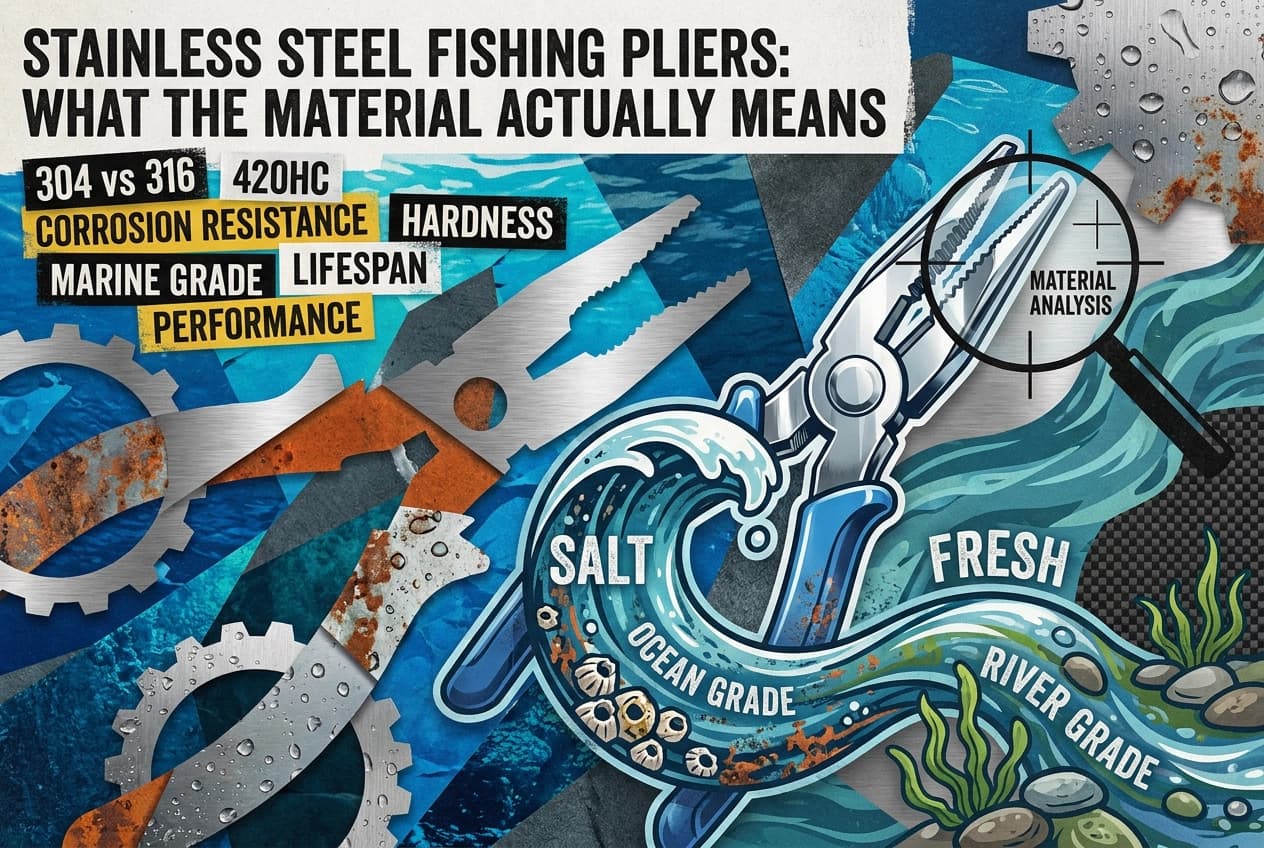
AI-generated header image for: Stainless Steel Fishing Pliers: What the Material Actually Means
Not all fishing pliers are created equal, and the material they are made from matters far more than most anglers realize. If you have spent any time shopping for gear, you have likely seen the term "stainless steel fishing pliers" plastered across product listings without much explanation of what it actually means for performance and durability.
Here is the truth: stainless steel is not a single material. It is a broad category of alloys, each with distinct properties that directly affect how your pliers hold up against saltwater corrosion, heavy use, and the test of time. Choosing the wrong grade can mean rusted jaws after a single season, while choosing the right one can give you a tool that outlasts several rods and reels combined.
In this post, we are going to break down what stainless steel actually means in the context of fishing pliers, compare the most common grades you will encounter, and help you understand exactly what to look for before making a purchase. By the end, you will know how to read past the marketing language and buy with confidence.
Stainless Steel Grades Explained: 420HC vs. 316 Marine-Grade
Not all stainless steel is created equal, and nowhere does that truth hit harder than on a saltwater flat or an offshore spread where your tools take a daily beating from chloride-rich environments. The term "stainless steel" on a product label is essentially meaningless without a grade designation, and understanding the difference between 420HC and 316 marine-grade can be the deciding factor between pliers that last a decade and pliers that pit and seize after a single season.
420HC: Strong Performance with a Saltwater Caveat
420HC is a high-carbon variant of the 420 stainless family, heat-treated to achieve a working hardness typically in the 57 to 59 HRC range on the Rockwell scale. That hardness level matters significantly for a load-bearing tool like fishing pliers, where jaw teeth must maintain geometry under the torque of crimping heavy mono leaders, and cutting edges need to shear through thick braid without deforming. This makes 420HC a logical and legitimate choice for mid-range pliers used in freshwater or light inshore applications. The critical limitation, however, is chemistry: 420HC contains no molybdenum, the alloying element responsible for resisting chloride-induced pitting. According to saltwater knife testing data from Knife Depot, 420-series stainless can show visible surface rust within 48 to 72 hours of continuous saltwater exposure. For anglers who rinse and dry their tools after every outing, 420HC can perform adequately. For those who do not, degradation begins faster than most expect.
316 Marine-Grade: Built for the Saltwater Environment
316 stainless earns the "marine-grade" designation because of one key addition to its alloy composition: approximately 2 to 3% molybdenum. That molybdenum content reinforces the passive chromium oxide layer on the steel's surface, raising the threshold at which chloride ions can penetrate and initiate pitting corrosion. This is precisely why 316 is the standard alloy for boat hardware, dock fittings, and marine fasteners globally. The trade-off is hardness: annealed 316 stainless sits considerably softer than heat-treated 420HC, which means cutting edges on 316 pliers can wear faster under repeated heavy use. For serious inshore, offshore, or brackish estuary anglers, as corrosion resistance research consistently supports, marine-grade alloys represent the minimum viable standard. Searching specifically for pliers labeled "316 stainless" or "marine-grade stainless" rather than accepting a generic "stainless steel" claim is not over-caution; it is an informed buying decision backed by material science.
The HRC Factor and Making the Right Call
Hardness ratings determine real-world tool durability in ways that corrosion resistance cannot address alone. A pair of pliers with soft jaws will deform under repeated crimping loads, rounding off the teeth that give you mechanical grip. A pair with brittle cutting edges will chip rather than shear. The practical takeaway for intermediate anglers is straightforward: match the alloy to the environment. If your fishing is primarily inshore saltwater, offshore, or in brackish estuaries, prioritize a verified marine-grade stainless designation. If freshwater or occasional light-salt use describes your sessions, 420HC at the right hardness is a capable and cost-effective option, provided you maintain a consistent rinse-and-dry routine after every use. When a product only says "stainless steel" with no grade specified, treat that as a signal to ask more questions before purchasing.
Stainless Steel vs. Titanium: What the Real Comparison Looks Like
Titanium pliers occupy the top shelf of the fishing pliers market for legitimate technical reasons. The material is approximately 40% lighter than steel and delivers a corrosion resistance ceiling that exceeds even the best marine-grade stainless grades. Those properties are real. What is also real is the price gap that comes with them, with premium titanium pliers retailing between $150 and $400 or more depending on the brand. That price architecture has generated significant consumer pushback, with video content titled along the lines of "Fishing Pliers Shouldn't be $300" accumulating tens of thousands of views in 2025 and 2026 alone. Community voices in surf and saltwater fishing forums have been equally direct, with one widely cited Reddit comment summarizing the sentiment clearly: the only reason to buy top-tier titanium pliers is to own them, not because the performance gap justifies the spend for most anglers.
The pushback has also extended into material authenticity, which has become a genuine issue within the premium segment. Independent reviewers began subjecting $150-plus titanium pliers to magnet tests and multi-day saltwater immersion tests to verify whether the alloy advertised on the packaging is actually what ends up in the water with you. A real-world 10-day saltwater trip in late 2025 exposed a telling detail on one popular titanium model: while the plier body performed as expected, a stainless steel accessory component built into the same tool began visibly rusting after just four days of exposure. That finding points to a broader credibility gap, where even when a plier body is genuinely titanium, mixed-material construction can quietly undercut the corrosion resistance premium buyers are paying for. Top fishing plier testing methodology and category reviews from sources like Saltwater Sportsman reinforce that material verification is now a core evaluation criterion for informed buyers.
For the vast majority of saltwater anglers, marine-grade stainless steel resolves the corrosion problem without requiring a $300 investment. Properly rinsed and dried after each session, a quality pair of 316 marine-grade stainless pliers handles inshore, nearshore, and offshore demands across seasons. The cost-to-performance ratio simply favors stainless when measured against real-world fishing conditions rather than laboratory corrosion thresholds most anglers will never push.
Titanium's weight advantage does carry practical value, but that value is context-dependent. For kayak anglers, wade fishermen, and ultralight setups where cumulative gear weight compounds across every item on a vest or yak deck, shaving grams on pliers matters. For boat anglers with a full tackle spread, the difference between a stainless pair and a titanium pair in the hand is largely imperceptible. Comprehensive 2026 fishing plier roundups consistently reflect this nuance, identifying titanium as a legitimate choice for specific applications rather than a universal upgrade.
The replacement cost argument may be the most practical point of all for working anglers. Stainless pliers in the $20 to $50 range are straightforwardly replaceable if they go overboard, corrode beyond function, or simply wear out from daily guide service use. At $200 to $300, a titanium pair raises the stakes of every drop considerably. Guide services running multiple pairs simultaneously understand this arithmetic well, and B2B buying data confirms that commercial operators default to stainless and mid-tier aluminum at volume rather than absorbing titanium pricing across a full fleet of tools.
What to Look for in Stainless Steel Fishing Pliers
Knowing what separates a reliable tool from a frustrating one comes down to five functional checkpoints that serious anglers should evaluate before committing to any pair of stainless steel fishing pliers.
Jaw Design and Tooth Geometry
The jaw profile determines how confidently you can work split rings, back hooks out of deep-set positions, and manipulate small terminal tackle under pressure. Aggressively knurled teeth deliver real holding power on hard surfaces like split ring wire and weighted hooks, but a coarse tooth pattern can crush or deform soft wire leaders and light-gauge terminal hardware if you are not careful. The best jaw designs use a moderate knurl pattern that locks onto metal without shredding it, combined with a nose geometry narrow enough to access split rings on treble-hooked lures without levering the ring open accidentally. Evaluate the jaw tip width and the serration angle before you buy, because these two dimensions directly control the range of tasks the pliers can handle cleanly.
Spring Mechanism and Long-Session Performance
A spring-loaded return mechanism sounds like a small convenience, but after two hours of repetitive hook removals, the difference between a spring-assisted and a manual open is real and measurable in hand fatigue. The critical detail most buyers overlook is spring material. A carbon steel spring in an otherwise stainless body will rust out well ahead of the tool itself, leaving you with a pliers that requires two hands to operate and no longer functions as designed. Prioritize models where the spring is fabricated from the same corrosion-resistant alloy as the body frame, which ensures the weakest component does not become the first point of failure.
Line-Cutting Capacity
Built-in cutters need to handle at least 80-pound braided line with a clean, fringe-free cut. Budget options frequently harden the cutting edge as a secondary process, which means the blade edge degrades faster than the surrounding steel and loses clean-cutting ability after limited use. This is one of the most common functional failures in lower-priced pliers and one of the easiest to screen for by checking whether the cutter is integrated or appears to be a pressed insert. Sport Fishing Magazine's saltwater plier guide reinforces cutting performance as a primary saltwater selection criterion, particularly when heavy braided mainlines are standard.
Ergonomic Handle Design
Wet, fish-slimed hands are the operating condition, not the exception. Rubberized or deeply textured grips provide the friction needed to maintain positive control when palms are slick, and they also reduce the grip force required to hold the pliers securely, which compounds the fatigue-reduction benefit of the spring mechanism. Handle geometry matters alongside grip material; a handle that forces an unnatural wrist angle will cause fatigue regardless of how good the rubber coating is. According to Smith's Products fishing pliers buyer guide, handle ergonomics consistently rank among the top buyer priorities alongside material quality and cutting performance.
Sheath and Storage System
Stainless steel is durable, but prolonged contact with wet fabric, salt residue, and compressed gear inside a tackle bag will surface-scratch and promote staining even on 316-grade material. A dedicated sheath or holster with a positive retention clip keeps the pliers protected between uses and accessible when you need them quickly. A retention system that requires two deliberate steps to release is preferable to a friction-only design that can drop the pliers overboard during a rough retrieve. Secure storage is not just a convenience feature; it is an active part of extending the functional life of the tool.
Saltwater Use: Why the Right Stainless Steel Holds Up
Saltwater fishing doesn't give your tools a break. Every trip introduces a continuous corrosion cycle driven by chloride ions that attack metal surfaces at the molecular level, penetrating microscopic surface irregularities and destabilizing the protective chromium oxide layer that standard stainless relies on for rust resistance. This is why alloy grade matters far more than surface finish or coating thickness. A pair of pliers labeled "stainless steel" can still fail within a season of inshore fishing if the underlying grade lacks the molybdenum content required to resist chloride penetration in sustained marine exposure.
The Budget Trap Most Anglers Fall Into
Coated or anodized carbon steel pliers represent one of the most common and costly mistakes in a saltwater angler's kit. The coating performs adequately out of the packaging, but the moment it takes a nick from a hook, a scratch against a gunwale, or a chip from a tackle box rattling around on a rough offshore run, the base metal underneath is fully exposed to seawater. Corrosion doesn't wait. In a high-salinity environment, bare carbon steel can begin showing aggressive rust within a single trip, and the deterioration accelerates from there. According to Fishing Pliers Material Selection Guide 2026, aluminum alloy alternatives with anodized finishes are explicitly categorized as suitable only for freshwater or lightweight portable use due to their moderate corrosion resistance ceiling. The surface treatment is not the protection; the alloy is.
How Marine-Grade Stainless Actually Holds Up
316-grade stainless steel resists chloride attack through a passive oxide layer that doesn't just sit on the surface but actively self-repairs when exposed to oxygen. When that layer is disrupted, it reforms naturally, which is the core mechanical advantage over any coated alternative. Verified buyer data from over 1,100 Amazon reviews shows 77% five-star ratings for quality stainless steel fishing tools, with corrosion resistance cited as the leading praise point. That real-world feedback confirms what the metallurgy predicts.
Maintenance Still Matters
Even marine-grade stainless benefits from a deliberate post-trip rinse with fresh water. The pivot joint and spring mechanism are the most mechanically vulnerable points on any pair of fishing pliers. Salt crystals accumulate in the hinge gap during a session, and if left to dry there repeatedly, mineral deposits can seize the pivot over time, stiffening or locking the action entirely. A thorough rinse directed at the joint, followed by leaving the pliers open to air-dry, keeps the mechanism operating cleanly across a full season.
Inshore Conditions Demand Daily Durability
Targeting redfish, snook, and tarpon in shallow inshore flats and backcountry estuaries creates some of the most demanding corrosion conditions an angler can put a tool through. Shallow water concentrates salinity, tidal movement keeps tools in repeated contact with brine, and the physical demands of handling large, aggressive fish mean pliers take real abuse on every outing. Corrosion resistance in this context isn't a long-term concern; it's a session-by-session requirement that separates tools that last from tools that get replaced.
Freshwater Use Cases: Bass, Catfish, and Pike
Freshwater anglers frequently underestimate what their pliers are actually going through. While saltwater corrosion gets most of the attention, heavy-use freshwater fishing places its own brand of mechanical stress on tools, and cheap painted or coated steel alloys degrade faster than most anglers expect. Tannic river water, fish slime, muddy bottom environments, and repeated pressure on terminal tackle all accelerate corrosion and joint wear in low-grade pliers. Stainless steel construction addresses this not by being a saltwater-only upgrade, but by providing a baseline of hardness and corrosion resistance that holds up under real fishing conditions regardless of water type.
Pike, Muskie, and the Case for Jaw Geometry
Pike and muskie anglers work under a specific set of physical constraints that make jaw geometry and reach genuinely critical. Large lures loaded with treble hooks, combined with a thrashing fish capable of serious hand injury, demand a plier with enough reach to keep fingers clear and enough jaw strength to grip and back out hooks cleanly. A tool length of 7 inches or more is advisable for this application, providing the mechanical leverage and safe working distance that shorter bass-oriented pliers simply cannot offer. Hardened stainless jaws resist deformation even when torqued against deeply set hooks in bony fish mouths, where softer alloys would flex or splay under load. The build quality requirement here is functionally comparable to what saltwater anglers face; the species and environment are different, but the mechanical demands are not.
Catfish Rigs and Crimping Loads
Catfish fishing puts a different kind of stress on pliers, one focused on crimping and cutting rather than hook removal reach. Heavy circle hooks, crimp sleeves, thick monofilament or braided leaders, and occasional wire components are standard in serious catfish rigging, and each element places a load on the jaw and cutter that softer alloys cannot sustain repeatedly. A hardened stainless jaw maintains its edge geometry and grip surface across hundreds of crimps, while a cheaper alloy begins to deform and lose precision relatively quickly. Replaceable tungsten-carbide cutters, increasingly standard in quality mid-tier pliers, handle the thick lines common in bottom-fishing rigs without the blade fatigue that hollow-ground alternatives develop over time. For anglers who rig frequently or fish high-volume catfish operations, this durability difference adds up across a season.
Bass Tournament Use and Split-Ring Reliability
Bass tournament anglers operate in a high-rotation environment where hardware changes between rounds are routine, and slow or sticky tools create real problems under time pressure. Split-ring pliers that bind due to corrosion buildup in the hinge or tip mechanism cost time and composure during pre-tournament prep. A stainless steel pair with a spring-loaded return and clean action through repeated cycles eliminates that variable entirely. According to The Best Fishing Pliers of 2026, build quality and smooth operation are consistent selection criteria across serious angler use cases. Stainless steel delivers that operational reliability at a price point well below titanium, making it the practical choice for tournament anglers who need a dependable tool without absorbing a premium materials cost. For freshwater anglers across all three of these use cases, stainless steel sits in a well-defined performance tier: a meaningful durability upgrade over painted steel alternatives, without the cost ceiling that titanium commands.
How to Care for and Maintain Stainless Steel Fishing Pliers
Even the best marine-grade stainless steel pliers will underperform and fail prematurely without consistent maintenance. The good news is that proper care requires only a few minutes after each trip, and that investment compounds significantly over time. Well-maintained stainless pliers have been documented lasting fifteen or more years in active saltwater use, while neglected pairs can begin seizing and corroding within a single season.
Rinse thoroughly after every saltwater outing. Fresh water is your first and most important line of defense. Focus the rinse directly at the pivot joint and spring mechanism, since salt crystals accumulate fastest in these recessed areas and can physically seize moving parts if left to build up across multiple trips. Run fresh water through the joint while working the pliers open and closed several times to flush out any crystallized deposits trapped in the mechanism. This step takes under a minute and prevents the most common cause of plier failure in saltwater environments.
Lubricate the pivot point and spring after drying. Once you have rinsed and towel-dried the pliers, apply a light coat of corrosion-inhibiting oil to the joint area. PTFE-based lubricants and dedicated reel oil both perform well here, creating a barrier against mineral deposit buildup while keeping the action smooth. Products like Boeshield T-9 offer longer-lasting protection than standard water-displacing sprays, which tend to evaporate quickly and leave less residual film. Apply a small amount, work the joint several times to distribute it evenly, and wipe away any excess. For saltwater fishing, repeat this process after every trip. For freshwater use, monthly lubrication is generally sufficient depending on frequency of use. Donnmar Pliers' maintenance protocol reinforces this routine as the core of long-term plier care.
Dry completely before storage, and store in a ventilated space. Moisture trapped inside a sheath or sealed tackle bag continues working against the steel even after you have left the water. Towel-dry the pliers thoroughly, then allow them to air-dry for several minutes before sliding them into a sheath or belt holster. Avoid sealing them in a wet bag or zipped compartment while any moisture remains on the surface. Ventilated storage, such as a mesh pouch or an open holster in a well-aired tackle area, allows residual moisture to evaporate and dramatically reduces the risk of prolonged contact corrosion developing in the joint area. Even marine-grade 316 stainless steel can develop surface oxidation when moisture is held against it continuously.
Inspect and maintain the line cutter blade on a regular schedule. Cutter blades experience the most concentrated mechanical stress of any component on your pliers, and edge rollover or minor chipping is a normal result of regular use on braid and mono. Periodically hold the cutter up to light and examine the edge for flatness or visible chips. A fine sharpening stone or dedicated blade hone applied at a consistent angle can restore a clean cutting edge and extend the tool's functional life considerably. Restoring the edge before it degrades fully is far easier than recovering a heavily damaged blade later. According to gomdorifishcamp.com's fishing pliers guide, dull and bent cutters are among the most common failure points in lower-quality pliers, and even premium tools benefit from periodic edge maintenance to sustain that clean single-squeeze cut on heavy braid.
For Guide Services and Tournament Anglers: Why Tool Quality Scales
For fishing guides and tournament anglers, the math on tool quality is straightforward once you calculate usage volume rather than purchase price. A working guide running 150 trips per year will reach for their pliers 20 or more times per trip during hook removals, line cuts, split ring swaps, and leader adjustments. That totals roughly 3,000 individual uses per season. A budget pair priced under $30 is not engineered for that cycle. Springs weaken, cutter edges dull against braid, and jaw alignment drifts under repeated load. By mid-season, the tool becomes a liability rather than an asset. When the cost is distributed across 3,000 uses, a professional-grade stainless pair at three to four times the price delivers a dramatically lower cost-per-use, while consistently performing when it counts.
Tournament anglers face a different but equally critical pressure point: time. In competitive bass fishing, for example, livewell transfers and hook removals happen in compressed windows where every second affects placement. A spring that seizes mid-fish, a cutter that frays fluorocarbon instead of cutting it cleanly, or jaws that slip when backing out a treble hook are not minor inconveniences in that context. They are performance failures. Professional-grade stainless steel fishing pliers with tungsten carbide cutters and spring-loaded jaws eliminate those variables before they can surface during a critical moment on the water.
For guide operations equipping multiple boats or rotating seasonal staff, per-unit cost scales quickly across a fleet. BasicGearTackle.com addresses this directly through wholesale pricing structured for guide services, bait shops, and tackle retailers, allowing operations to equip every boat with consistent, professional-grade tools without absorbing full retail cost on each unit.
Tool standardization across a guide fleet carries a safety dimension that is easy to overlook. When every staff member uses the same pliers with the same grip geometry and the same release mechanism, training is faster and client-facing fish handling becomes more predictable. Consistent tools reduce the variables that contribute to hook-related incidents when clients are in close proximity during unhooking.
Tournament teams have an additional access path worth noting. BasicGearTackle.com supports competitive fishing teams through sponsorship programs that include access to their full tool line, giving serious tournament anglers a structured way to run professional-grade gear at reduced cost while maintaining the reliability their competition schedule demands.
How Stainless Steel Pliers Fit Into Your Complete On-the-Water Tool Kit
Stainless steel pliers are the anchor of any serious fishing kit, but their performance ceiling is directly tied to the quality of everything surrounding them. A complete on-the-water system means pairing your pliers with a quality fillet knife, braid scissors or line cutters, a reliable dehooker, and a landing net that meets the same corrosion-resistance standard. When one component in that chain fails, the entire workflow breaks down at the worst possible moment, whether you are managing a thrashing pike boatside or quickly releasing a redfish on a saltwater flat.
The mismatched-gear problem is real, and it is something most intermediate anglers run into after sourcing individual tools from different brands across different quality tiers. BasicGearTackle.com addresses this directly by offering fishing tool kits that bundle stainless steel pliers with complementary tools, giving anglers a cohesive system built to a consistent standard from the start. Buying a matched kit eliminates the guesswork around material compatibility and ensures every tool in your rig is rated for the same conditions you are fishing.
The corrosion-resistant philosophy extends beyond pliers to every item touching saltwater. Baitwell nets, landing nets, and crab traps that share the same material standard as your pliers are far easier to maintain as a unified system. You rinse, inspect, and store everything with the same protocol rather than managing separate care routines for components built to different tolerances. That consistency reduces the chance of a single weak link degrading your overall kit reliability over a full season.
For kayak anglers, the space constraint makes this systems approach even more important. A compact, corrosion-resistant tool kit stored in a tackle crate or tray needs every component pulling its weight without taking up excess room. A stainless plier paired with a quality fillet knife and a compact landing net covers the core functions efficiently and keeps critical gear within reach without cluttering a limited cockpit footprint.
Professional guides and tournament anglers have long approached gear selection this way, evaluating individual tools not in isolation but as components of a complete system. A high-quality pair of stainless steel fishing pliers is a strong starting point; building the right kit around them is what converts good individual gear into a reliable, high-performance setup that holds up across a full season of hard use.
BasicGear Stainless Steel Fishing Pliers: Built for Serious Anglers
BasicGear's stainless steel fishing pliers are built around a straightforward premise: serious anglers need tools that perform without hesitation, trip after trip, in conditions that would destroy lesser gear. Constructed from 17-4 PH stainless steel, a precipitation-hardened grade that delivers both high tensile strength and genuine corrosion resistance, these pliers are rated explicitly for saltwater use. Each pair integrates a built-in line cutter, hook remover, and split ring tool, covering the full functional range that intermediate and advanced anglers rely on across species, environments, and techniques. The engineering standard applied here matches what the brand calls a philosophy of refusing to compromise, and it holds consistently across their entire product line.
That consistency is backed by a track record that matters in a market where material claims are increasingly scrutinized. BasicGear's press credentials include over 100,000 cast nets sold, a 4.6-star average across more than 3,400 Amazon ratings, and three separate Amazon #1 Best Seller designations earned in 2022, 2023, and 2026 across different product categories. Those numbers represent real-world validation from anglers who purchase, use, and return to the brand repeatedly. When a company earns that kind of platform credibility across multiple product lines, it signals manufacturing discipline that carries over to newer additions like the pliers.
Pliers are available individually or bundled into 4-piece and 6-piece fishing tool kits, giving anglers a practical path to building a unified, corrosion-resistant setup under one quality standard. For tackle shops, bait shops, sporting goods retailers, and guide services, wholesale pricing is available with volume-tiered discounts, access to 220-plus SKUs, and dedicated support on a two-business-day response cycle.
For competitive anglers, the BasicGear ambassador program provides direct access to professional gear, including early product releases and restocking support, with no minimum follower requirement. It is a practical entry point for tournament anglers who simply want tools they can trust under pressure.
Conclusion: Choose the Material, Choose the Performance
The foundation of every smart pliers purchase is the same: prioritize alloy grade over aesthetics. A polished coating or anodized finish tells you nothing about long-term corrosion resistance. Marine-grade stainless with molybdenum content delivers measurable chloride resistance that generic "stainless steel" designations simply cannot match in saltwater or high-humidity environments.
The titanium versus stainless debate is worth taking seriously, but for most anglers the value case for marine-grade stainless steel remains compelling. Comparable corrosion resistance, significantly lower cost, straightforward replacement, and no material authenticity concerns add up to a practical advantage that premium titanium pricing rarely justifies.
Maintenance closes the performance gap between alloys. Rinse thoroughly, dry completely, and apply a light coat of oil after every saltwater trip. That three-minute routine consistently extends tool life regardless of which alloy grade you choose.
Your pliers perform best as part of a cohesive, professional-grade kit. Match tool standards across your entire setup and the system holds together under pressure.
Whether you fish inshore flats, bluewater offshore, freshwater reservoirs, or run guide trips full-time, the right stainless steel fishing pliers deliver consistent, unapologetic performance across every scenario. Choose the material deliberately, and the performance follows.
Keep reading