Georgia Red Drum Regulations 2026: New Slot and Bag Limits and What They Mean for Your Gear Setup
AI-generated header image for: Georgia Red Drum Regulations 2026: New Slot and Bag Limits and What They Mean for Your Gear Setup
If you cast a fishing net in Georgia's coastal waters this fall, the rules governing what you keep have fundamentally shifted. As of August 27, 2026, Georgia DNR's amended red drum regulations reduce the daily bag limit from five fish to three and tighten the slot to 15–24 inches total length. These aren't minor administrative tweaks. They reflect a serious 2024 ASMFC stock assessment finding that southern red drum are both overfished and experiencing active overfishing across Georgia, South Carolina, and Florida.
Under Georgia law (O.C.G.A. 27-1-2(36)(I) and 27-4-5), red drum are classified as gamefish and may only be taken by rod and reel. Cast nets are used in red drum environments for bait and live shrimp collection, not for targeting or retaining red drum. Incidental capture of red drum in a bait net does occur, and any red drum encountered that way must be immediately released regardless of size or slot status. The 2026 rule changes affect both how rod-and-reel anglers pursue keeper reds and how bait-net anglers must handle any red drum they encounter as bycatch.
This analysis breaks down exactly what changed, why Georgia DNR made these moves, and how to adjust your gear setup and technique to fish legally and effectively under the tighter limits. It also examines whether neighboring states are likely to follow suit.
What Actually Changed: The 2026 Georgia Red Drum Rules at a Glance
Georgia's red drum rules changed on August 27, 2026, and the shift is immediate and enforceable. The Georgia Board of Natural Resources voted on August 25, 2026 to approve two specific amendments to the state's saltwater fishing regulations, both of which are now in effect.
The two rule changes are:
Daily creel limit: Reduced from 5 fish to 3 fish per angler per day
Legal slot size: Adjusted from 14–23 inches total length to 15–24 inches total length
The slot adjustment deserves careful attention. The floor moved up one inch (from 14 to 15 inches), and the ceiling moved up one inch (from 23 to 24 inches). The result is a window that shifts slightly larger but does not widen. Any red drum under 15 inches or over 24 inches must be released, regardless of how it was caught.
These changes are projected to reduce red drum harvest by approximately 22.5%, which exceeds the minimum reduction threshold required under the Atlantic States Marine Fisheries Commission (ASMFC) interstate fishery management plan. That figure is not a target range; it is the documented outcome modeled from these specific rule parameters.
The regulatory process included meaningful public input. Georgia DNR's Coastal Resources Division conducted an online survey in March 2026 that drew responses from more than 760 participants, a level of angler engagement that reflects how closely the coastal fishing community was tracking these proposed changes. Public comment formally closed on June 30, 2026.
These rules are not pending review or phased in. As of August 27, 2026, they govern every angler fishing Georgia coastal waters. There is no grace period.
For anglers collecting bait in red drum habitat, the one-inch shift in the slot floor changes which incidentally captured fish are within the legal slot, and the 3-fish daily limit for rod-and-reel anglers means every red drum encounter carries more weight. The practical side of that compliance challenge, including what net configurations handle bait collection while minimizing red drum bycatch, is covered in the sections that follow. If you also use a cast net for bait collection, the complete guide to cast net gear and technique for shrimp covers gear selection and deployment strategies that transfer directly to inshore red drum environments.
Why Georgia DNR Made These Changes: The Stock Assessment Behind the Rules
Those new rules didn't come from a policy preference. They came from hard data showing a fishery in documented decline.
The 2024 ASMFC Benchmark Stock Assessment confirmed what fisheries managers had suspected: the southern red drum stock covering South Carolina, Georgia, and Florida is both overfished and experiencing ongoing overfishing. The key metric is spawning potential ratio (SPR), which measures whether enough mature fish remain to sustain reproduction. The southern stock's three-year average SPR fell below the 30% threshold considered the minimum safe biological level, meaning the population cannot replace itself at current harvest rates. Juvenile recruitment has also declined since the 2000s, narrowing the stock's natural recovery buffer.
That assessment triggered action at the interstate level. The ASMFC adopted Draft Addendum II to the Red Drum Fishery Management Plan in October 2025, establishing a binding, coordinated framework across Atlantic states rather than allowing each state to respond independently. Georgia no longer had the option to hold its existing limits. The addendum set minimum harvest reduction benchmarks that member states must meet through enforceable regulation changes.
Georgia's 2026 amendments directly satisfy those benchmarks. The projected 22.5% harvest reduction exceeds the interstate plan's minimum requirement, but the point is compliance, not precaution. This is a mandated response to a documented overfishing condition, and that distinction matters for understanding how long these rules will last.
ASMFC's stock data for Georgia projects a 5 to 6 year rebuilding window to reach the 30% SPR threshold, depending on how consistently fishing mortality is reduced. That timeline runs through at least 2031 to 2032. Anglers should plan around these limits being permanent features of Georgia fishing for the foreseeable future.
There is one additional implication that applies directly to how you fish: even catch-and-release encounters with undersized or oversized red drum add cumulative handling stress to a stock already operating below safe reproduction levels. Quick hook removal matters here; a reliable fishing hook remover tool reduces the time a fish spends out of water and lowers post-release mortality. For a recovering stock, every released fish's survival counts.
How a Tighter Slot Changes the Way You Fish with a Cast Net
That scientific context matters because it reframes what fishing with a cast net means in Georgia's current regulatory environment. Cast nets are used in Georgia's tidal creeks, marsh edges, and grass flat systems primarily to collect live shrimp and finfish bait. Red drum are not a legal cast net target. Under Georgia law (Rule 391-2-4-.04 and O.C.G.A. 27-4-5), they are gamefish that may only be taken by rod and reel. What the 2026 slot shift from 14–23 inches to 15–24 inches changes for bait net users is how they must handle the red drum they encounter incidentally while working those environments.
The one-inch upward shift in the minimum size has an immediate practical consequence. Fish that previously sat just inside the old legal floor are now out-of-slot, so bait net throws in areas holding juvenile reds are more likely to produce fish that must be released. The upper-end expansion to 24 inches creates a parallel issue on the other end: areas near Georgia's coastal inlets and nearshore structure hold larger adult fish, including bull reds that routinely exceed 24 inches. These fish are spawning-age adults, the exact cohort the rebuilding timeline depends on. Capturing them incidentally in a bait net imposes stress that accumulates across a fishery-wide scale.
For rod-and-reel anglers, the combined effect is a slot that narrows the margin on both ends. The practical shift for bait net users is primarily one of location awareness: choosing where to work a bait net with some knowledge of the size classes present reduces the frequency of red drum bycatch encounters.
For a full breakdown of how net size, mesh specifications, and throwing form affect which fish you actually capture, Cast Net Fishing: The Complete Guide for Serious Anglers covers the gear variables in depth.
Choosing the Right Cast Net: Mesh Size and Net Diameter for the 15–24 Inch Slot
Precision on the deployment side only gets you so far if the net itself is working against you. For bait collection in red drum environments, mesh size and diameter affect not just what bait you retain, but how many juvenile red drum end up as bycatch requiring immediate release.
Mesh size is the primary filter. Finer mesh retains smaller fish alongside bait, which creates more bycatch sorting under a tighter slot. Coarser mesh allows juveniles to pass through before the net closes. As a commonly recommended starting point for inshore bait collection, a 3/8-inch to 5/8-inch mesh balances juvenile escape against bait retention. Water depth, tidal current, and how quickly the net sinks all influence actual selectivity, so mesh size is a starting point rather than a guarantee. A mesh size reference table can help you cross-reference mesh opening against target species and size range before you commit to a specific net.
Net diameter controls the coverage footprint. The problem with a large-diameter net in a mixed-size area is that more surface area encloses more fish across a broader size range, and a higher proportion are likely to be out-of-slot reds requiring immediate handling and release. A smaller, precisely placed net reduces that exposure. The trade-off is intentional: you give up maximum coverage in exchange for cleaner bait collection with fewer bycatch encounters.
Lead-per-foot rating affects how quickly the net seals. A heavier lead line drives the skirt down faster, shrinking the gap between the net's edge and the bottom. In Georgia's tidal creeks and marsh channels, a slow-sinking net gives fish more time to exit before closure. As a general starting point for inshore bait collection, a net rated at 1.5 to 2 pounds per foot provides meaningful closure speed without making the throw unmanageable for most inshore anglers.
BasicGear cast nets are designed with these inshore variables in mind, offering configurations across multiple mesh sizes, diameters, and lead ratings suited to the tidal creek and nearshore environments where Georgia red drum concentrate.
Deployment Technique Adjustments That Reduce Out-of-Slot Encounters
Selecting the right net is only half the equation. How and when you throw it determines whether your gear choices translate into cleaner bait collection with fewer red drum bycatch complications.
Sight casting is the single most reliable technique for bait anglers who want to reduce incidental red drum capture. Georgia's tidal flats and marsh edges can allow anglers to visually assess school composition before committing to a throw when water clarity permits. If the fish running through a flat look like juvenile reds rather than bait, hold the cast. Throwing a bait net over concentrations of juvenile red drum adds unnecessary handling stress on a stock regulators are actively trying to rebuild, as already discussed.
Blind throwing changes the calculus entirely. In areas where red drum are known to concentrate, such as oyster bars, grass flat edges, and tidal creek mouths, blind throws produce out-of-slot encounters at a meaningfully higher rate. Avoid them in those locations when bait collecting.
Choosing a smaller-diameter net with a faster sink rate reduces incidental red drum capture rather than targeting them more precisely. A tighter opening circle encloses a narrower horizontal slice of a school, reducing the range of fish sizes captured in a single throw. You sacrifice coverage area for compositional selectivity, which is the right trade-off when working areas that hold red drum alongside bait.
Timing matters in moving water. Current-induced drift causes the net skirt to travel laterally as it sinks, widening your effective capture zone. Throwing at or near slack tide in tidal creeks and marsh channels keeps the net skirt falling on a tighter vertical axis, improving both placement accuracy and enclosure reliability.
Before deploying a cast net on an unfamiliar flat, a seine net used as a bait survey tool gives you size distribution intelligence before you commit a throw. A short seine pull through shin-deep water reveals whether the area holds primarily juvenile reds or usable bait. This pre-survey step costs a few minutes and can prevent multiple out-of-slot captures. For anglers building a kit around the new regulations, carrying both a seine net and a cast net is practical preparation, not redundancy.
Handling Out-of-Slot Red Drum: Minimizing Stress on a Recovering Stock
Even the sharpest deployment technique will occasionally produce an out-of-slot fish in a bait net. How you handle that fish in the next thirty seconds determines whether it survives. As established, any red drum encountered in a cast net must be released immediately regardless of size.
Release is mandatory for any red drum below 15 inches or above 24 inches total length under Georgia's 2026 rules, per the state's recreational finfish limits. The obligation is immediate, but so is the opportunity to do it well.
Sort in the Water, Not on the Deck
When net fishing yields out-of-slot fish, resist pulling the net fully aboard before sorting. Keep as much of the net submerged as possible and identify non-keepers while the fish remain in the water column. Air exposure is the primary driver of stress-related mortality in released fish; even a short time on a hot fiberglass deck can cause physiological damage that kills fish hours after they swim away. The goal is to move bait into the livewell, return any red drum bycatch over the gunwale, and do both in a single fluid sequence.
Handling Protocol for Released Fish
Wet your hands before contacting any fish. Dry hands strip the protective slime coat, accelerating infection risk after release.
Use a rubber-coated net if you need to support a larger out-of-slot bull red during measurement. Knotted nylon abrades scales and gills.
Measure quickly, decide quickly. A borderline fish should spend seconds on a measuring board, not minutes. If you need a reliable hook removal step before release, a quality fish hook remover reduces handling time and minimizes tissue damage compared to improvising with pliers.
Return the fish headfirst into the current when possible, supporting it until it swims out of hand.
Do Not Stage Out-of-Slot Fish in a Livewell
Stacking non-keepers in a baitwell while you finish sorting a net load compounds stress, depletes oxygen, and delays release. Identify and return each out-of-slot fish immediately over the side. With a 3-fish daily rod-and-reel limit now in effect, each released fish carries real demographic weight in a stock the ASMFC has confirmed is overfished. Under the previous 5-fish limit, one released fish represented 20% of a day's bag; under the new limit it represents 33%. Proper handling is the angler's direct contribution to the rebuilding timeline the southern red drum stock depends on.
Will South Carolina and Florida Follow? The Interstate Regulatory Outlook
Georgia's conservation responsibility doesn't end at its state line. The southern red drum stock is a shared resource spanning Georgia, South Carolina, and Florida, and the stock condition described earlier applies equally to all three states.
ASMFC's Addendum II creates the mechanism for coordinated action. It doesn't mandate identical slot sizes or creel limits across state lines, but it establishes a formal framework requiring each state to demonstrate sufficient harvest reductions. Georgia has moved first and exceeded the minimum threshold. That puts regulatory pressure on South Carolina and Florida to demonstrate comparable reductions through their own regulatory cycles, or face board-level intervention.
South Carolina's Exposure
South Carolina anglers fishing the Savannah River corridor and the coastal waters near Hilton Head are already operating in mixed-jurisdiction territory. If South Carolina adopts a 15-24 inch slot in a future regulatory cycle, which is a realistic outcome under Addendum II's framework, anglers using gear calibrated to the old Georgia slot will face an immediate compliance gap. Reviewing net mesh size and deployment habits now, before any South Carolina rulemaking is finalized, costs nothing and avoids a scramble later.
Florida's Atlantic Coast Position
Florida's Atlantic coast fishery is part of the same southern stock designation. Florida has already made independent regulatory changes that reduced its Atlantic coast red drum harvest, which the stock assessment noted explicitly. Further alignment with the ASMFC framework's new reference points is a credible near-term possibility for Florida's Atlantic-side regulations.
The Cross-State Gear Strategy
For anglers who move between Georgia, South Carolina, and Florida's Atlantic coast, reconfiguring nets at every state boundary is impractical. The more durable approach is to build a gear setup around the most restrictive slot currently in force, which is Georgia's new 15-24 inch limit, and fish to that standard everywhere. This is the same logic that applies when choosing among different net styles for different species: selecting specifications that cover the broadest compliant range is more efficient than maintaining separate configurations. The same principle covered in detail for freshwater applications in this guide to catfish net types and specs holds in inshore saltwater contexts as well. Fish to the tightest standard in your range, and every state you visit is already covered.
A Practical Gear Checklist for Fishing Under the New Georgia Slot Limits
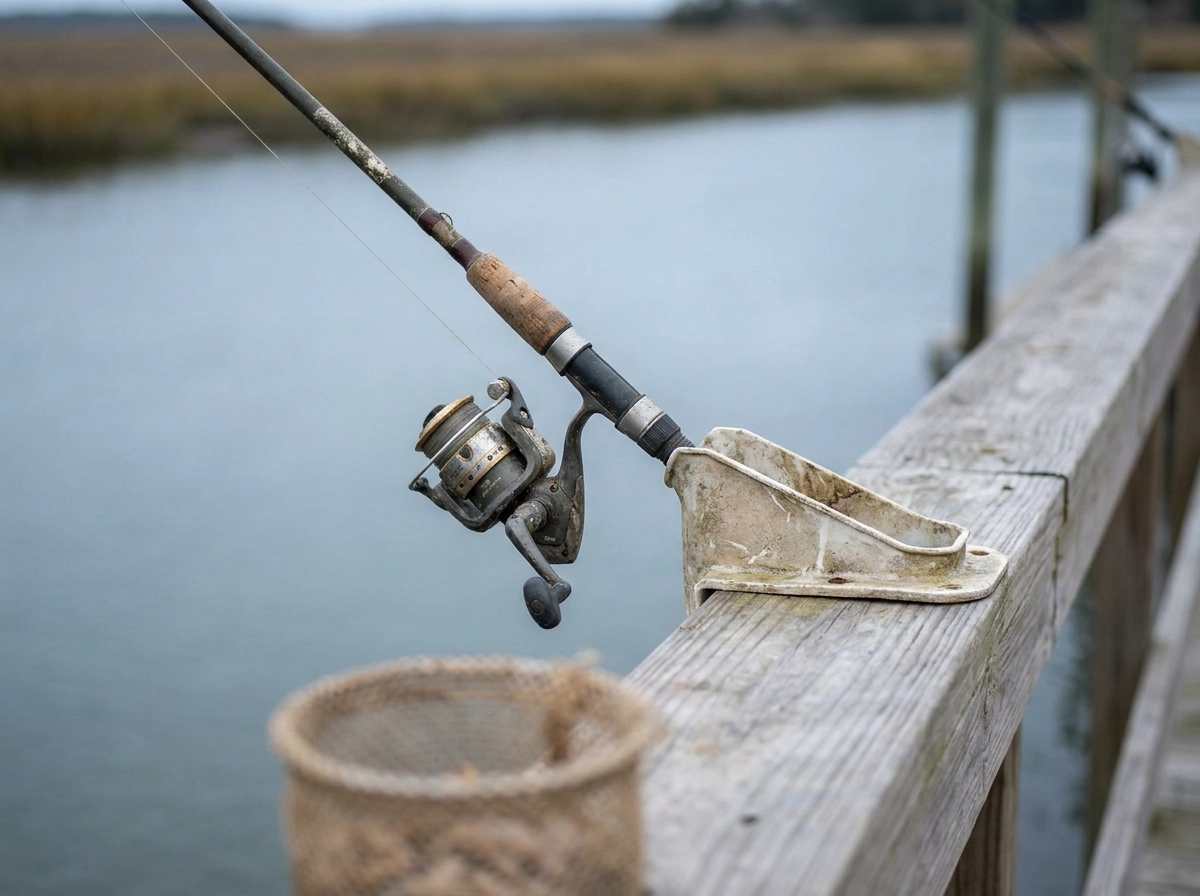
Note: Under Georgia law (Rule 391-2-4-.04 and O.C.G.A. 27-4-5), red drum are designated gamefish and may only be taken by rod and reel. Cast nets may be used for bait collection only; any red drum encountered in a cast net must be released immediately.
Building a gear setup that keeps you legal under the tighter 15–24 inch slot starts with auditing what you already own before your next trip.
Cast Net Mesh Size
Mesh size determines which fish your net retains and which pass through. A fine-mesh shrimping cast net designed for bait collection traps juveniles well below 15 inches, creating sorting problems and unnecessary handling stress when red drum are present as bycatch. As a commonly recommended starting point for inshore bait collection near red drum habitat, a 3/8-inch to 5/8-inch mesh allows smaller fish to exit while still collecting bait effectively. If your current net runs finer than that, it belongs in lower-risk bait environments rather than areas where juvenile red drum concentration is likely.
Net Diameter and Lead Weight
As a practical standard for Georgia's tidal creeks, marsh channels, and nearshore flats, a 10–12 foot radius net paired with a lead weight of 1.5–2 lbs per foot is commonly recommended for inshore bait collection. Heavier lead drives the net down faster, tightening the closure window. That speed advantage is especially relevant in moving current, where a slow-sinking net gives fish more time and more room to exit. If you want to sharpen your throwing mechanics before switching gear, this step-by-step guide to cast net technique covers setup, loading, and troubleshooting in detail.
Visual Assessment Tools
Polarized sunglasses are not optional for bait fishing in Georgia's inshore environments. They cut surface glare enough to let you read school composition before committing to a throw, giving you the best chance to identify juvenile red drum concentrations before you cast into them.
Release Tools
With the slot tightened on both ends, borderline fish are now more common, not less. A rubberized landing net, a wet rag, and a measuring board should all be immediately accessible, not buried in a storage compartment. Fast, accurate measurement shortens air exposure for fish that need to go back.
Gear Sources
BasicGear's cast net lineup spans the mesh sizes and lead-per-foot ratings most relevant to inshore bait collection in red drum environments. Their seine nets are a practical option for surveying fish size distribution on shallow flats before committing a cast net throw, reducing incidental out-of-slot red drum encounters before they happen.
Fishing Smarter Under Tighter Rules: What the 2026 Changes Demand from Serious Anglers
The gear checklist gets you equipped. What you do with that equipment, and why it genuinely matters, is a different conversation.
Georgia's 2026 regulations are a direct response to a documented overfishing condition, as covered earlier. The rebuilding window scientists project runs through at least 2031 to 2032. Anglers who treat this as a temporary inconvenience are misreading the timeline.
Rod-and-reel anglers face the nine-inch slot directly: every fish brought to hand must be measured, and only three keepers per day may be retained. Cast net users face it as bait collectors who must quickly identify and release any red drum bycatch, because those incidental encounters with a recovering stock carry real consequences if handled poorly. Mesh selection, net diameter, and deployment location all serve the same filtering function for both groups: reducing the time a recovering fish spends out of the water and ensuring it swims away in condition to contribute to the rebuilding timeline.
South Carolina and Florida anglers should read Georgia's 2026 changes as a directional signal. The specific slot dimensions may vary by state, but the conservation math is the same everywhere the stock is shared, and coordinated pressure for harvest reductions across the region is already built into the ASMFC framework.
Anglers who configure their gear around the 15–24 inch slot now, build reliable measuring habits, and refine their deployment approach to reduce out-of-slot encounters will be positioned to fish legally and productively through the entire rebuilding period. The regulations will likely stay restrictive. The anglers who adapt their gear and technique early will be the ones still fishing effectively when the stock recovers.
Conclusion
Georgia's 2026 red drum regulations represent a meaningful shift that demands an equally meaningful response from serious anglers. The core takeaways are straightforward: red drum may only be taken by rod and reel under Georgia law, cast nets in red drum habitat are for bait collection only and any red drum bycatch must be released immediately, the tighter 15 to 24 inch slot requires intentional gear selection, mesh size and net diameter directly affect which fish you encounter and must handle, and regional coordination signals that tighter rules are the new baseline across the Southeast.
The anglers who treat these changes as a gear and technique problem to solve, rather than an inconvenience to endure, will fish more productively throughout the rebuilding period.
Start now. Audit your cast net setup against the bait collection context it legally belongs to, build a reliable measuring routine for rod-and-reel fishing, and practice deployment adjustments that reduce out-of-slot red drum encounters in your bait net. The stock's recovery and your ability to keep fishing effectively are pointed in exactly the same direction.
Keep reading