Freshwater vs. Saltwater Cast Nets: What Changes and What Doesn't
AI-generated header image for: Freshwater vs. Saltwater Cast Nets: What Changes and What Doesn't
Most anglers who cast net fish regularly already know that throwing the same net in a tidal estuary and a freshwater reservoir produces different results. What fewer understand is exactly why, and more importantly, which specifications actually drive that difference. The water you fish in does not just change where you deploy; it changes which features of your net matter most before you ever make your first throw.
Saltwater introduces corrosion, denser bait species, and current conditions that demand heavier lead and corrosion-resistant materials. Freshwater rewards lighter profiles, finer mesh, and a more precise match to smaller forage. Buying a net without accounting for these distinctions means paying for specs that either underperform or actively work against you.
This guide breaks down every major specification point where fresh and salt diverge, including corrosion resistance, lead-per-foot weight, mesh gauge, material choice, and net radius. It also identifies the principles that hold true regardless of environment. By the end, you will have a clear, practical framework for matching the right net to your specific water, not to some generic average buyer.
The Core Difference: Environment Dictates Spec Priority
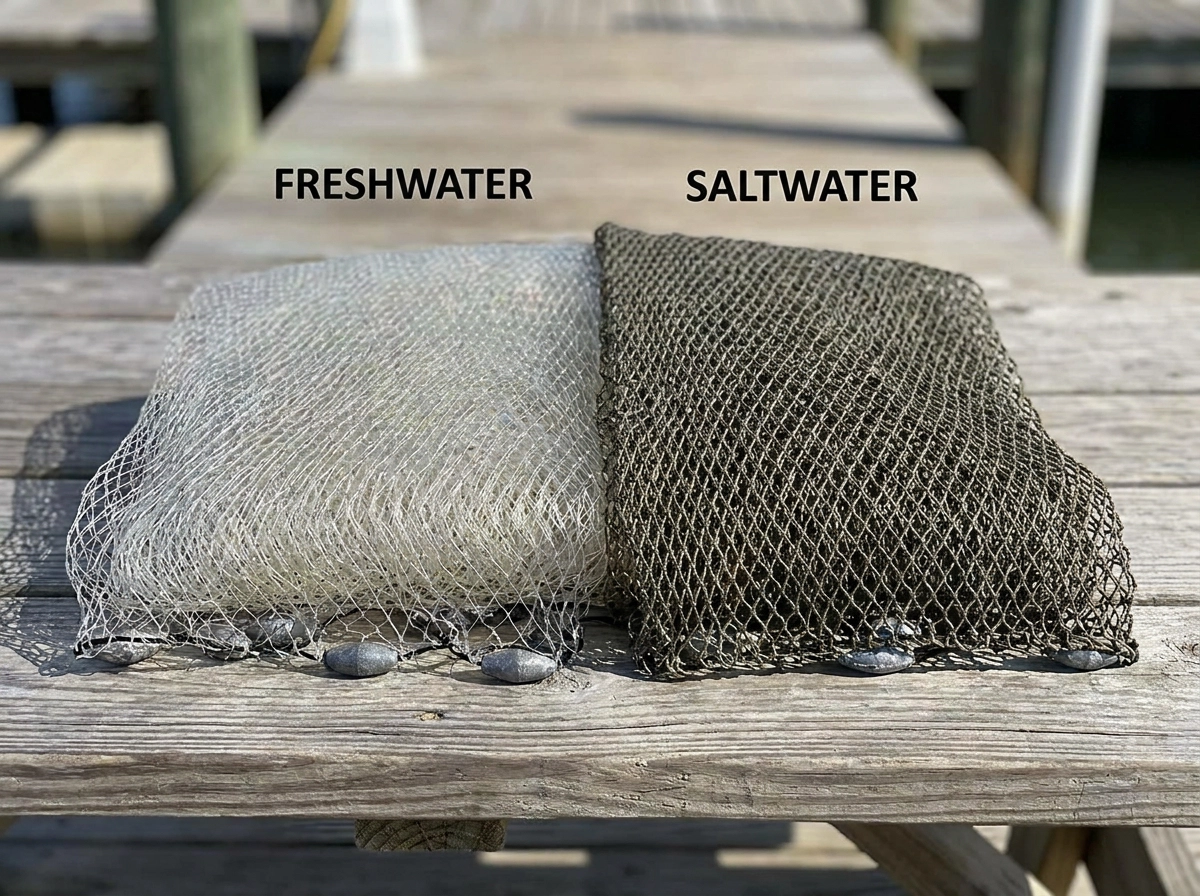
A cast net built for one environment will underperform in the other, sometimes badly. The specifications that matter most shift depending on whether you're fishing fresh or salt, and treating these nets as interchangeable is one of the more costly assumptions a buyer can make.
Saltwater introduces three compounding challenges that freshwater simply doesn't: accelerated corrosion on metal hardware, faster-reacting bait schools in open water that require faster net closure, and the need for heavier lead-per-foot ratios to close the net before fish scatter. These aren't minor tuning differences. They affect which materials survive a full season and whether you're actually catching bait or watching it escape.
Freshwater fishing with a cast net operates on different priorities. Targets like threadfin shad, golden shiners, and small perch are light-bodied and quick to spook. A lighter net with finer mesh is what produces consistent catches in shallower or tighter water. The same coarse mesh that works for mullet or pinfish in salt will let small freshwater forage push straight through.
Buyers who ignore this distinction pay for it twice: once at the register for hardware that corrodes ahead of schedule in saltwater, and again in missed catches when mesh that's too coarse fails to hold small baitfish. The same logic that drives anglers to research saltwater-rated baitcasters before buying the wrong reel applies directly to cast net selection.
Each of those five categories is examined in sequence below.
Corrosion Resistance: The Saltwater Specification That Has No Freshwater Equivalent
Saltwater is electrochemically aggressive in a way freshwater is not. When seawater acts as an electrolyte between dissimilar metals, galvanic corrosion begins working on ferrous hardware the moment immersion happens. Lead line swivels, crimping rings, and untreated metal components start oxidizing after repeated saltwater exposure if the hardware lacks a protective coating or corrosion-resistant alloy.
Galvanized lead versus coated lead is a genuine material distinction, not marketing language. Galvanized lead carries a zinc-oxide barrier that sacrifices itself to protect the underlying metal. That barrier breaks down fastest at cut edges and crimped points, exactly where saltwater infiltrates most aggressively. Once the zinc layer is compromised at a crimp, the exposed area corrodes without any remaining protection.
For shrimping cast nets and cast net seafood harvesting, operational intensity compounds this problem. Repeated throws in brackish or full-salinity water accelerate degradation considerably compared to occasional recreational use. Hardware that might last years under light use can show significant deterioration within a single shrimping season.
Monofilament netting holds up well against saltwater chemical breakdown, but the hardware connecting the net to the handline remains the more common failure point. The same principle applies to fishing pliers and other terminal gear; understanding how alloy grades affect real-world corrosion resistance in saltwater tools clarifies why material specification matters across your entire tackle setup.
For freshwater anglers, none of this applies. Hardware corrosion is negligible in fresh water, making this specification category irrelevant to a freshwater buying decision. That asymmetry is significant: saltwater buyers must actively evaluate corrosion specs; freshwater buyers can skip the category entirely.
Lead-Per-Foot Weight: Why Saltwater Nets Run Heavier
Beyond hardware corrosion, lead-per-foot weight is the most quantifiable specification gap between freshwater and saltwater cast nets, and it has a direct, measurable effect on catch rate.
Saltwater targets like shrimp, mullet, and pinfish school in open water and react quickly to surface disturbance. When a net hits the water, those fish move immediately. A heavier lead ratio drives the net to the bottom faster, closing the circle before the school scatters. In that context, more lead is not a preference; it is a functional requirement. Anglers scaling up from a 6-foot to a 10-foot saltwater net encounter a substantial jump in total lead weight, because both the larger radius and the faster sink-rate demands compound together.
A lighter lead profile serves freshwater applications well, reducing arm fatigue across a long bait-gathering session, which matters when you are throwing dozens of times before the first hook ever hits the water. For a full breakdown of how net weight affects throwing technique and session endurance, BasicGear's complete guide to cast net fishing covers the mechanics in detail.
The compromise problem is straightforward. An angler using one net across both environments either carries too much weight for accurate freshwater throws or too little to close reliably in salt. Neither outcome is acceptable when bait efficiency drives the entire fishing session.
Mesh Gauge and Opening Size: Matching the Net to Your Forage
Lead weight determines how fast your net sinks; mesh specifications determine what it actually catches when it gets there. These are separate decisions that compound each other.
Mesh gauge refers to the thickness of the individual strands. Mesh opening size refers to the square or diamond dimension of each cell. Both variables shift meaningfully between freshwater and saltwater applications.
Saltwater baitfish and shrimp are larger in body profile than most freshwater forage. A shrimping cast net typically runs mesh openings of 3/8 inch, with some practitioners using up to 1/2 inch depending on target species. That wider opening reduces water resistance during the throw, which helps the net spread faster and achieve a flatter, more complete circle on the water's surface.
For freshwater forage, 1/4 inch mesh is the standard starting point for small freshwater forage species such as threadfin shad, small shiners, and young-of-year perch. Coarser mesh lets small fish push straight through before you retrieve the net, and mid-sized forage can gill-net themselves in wider cells, which damages the bait and slows your haul. See the mesh size reference table for a full breakdown by species and opening dimension.
Gauge thickness also drives durability. Heavier-gauge strands resist abrasion from rocky saltwater structure and oyster beds. In open freshwater environments, that abrasion load simply does not exist, so finer gauge performs cleanly without sacrificing net life.
The mismatch cost is real in both directions: too coarse in freshwater and small forage escapes; too fine in saltwater and the net loses spread speed and sinking efficiency on every single throw.
Net Radius and Deployment Conditions: Where Environment Shapes Size Choice
Open saltwater and confined freshwater habitats impose different demands on net coverage.
In saltwater, open-water bait schools like mullet and pilchards scatter the moment a shadow hits the water. A wider spread is the only way to maximize your catch area per throw before the school disperses. Saltwater open-water applications often favor net radii in the 6- to 10-foot range, with larger options for experienced throwers suited to the physical demands of heavier nets.
Freshwater fishing with a cast net operates in fundamentally tighter spaces. Throwing under docks, along grass edges, in creek mouths, or across shallow flats puts a premium on control over coverage. A net in the 6-foot range or under is well suited to confined water, offering cleaner loading and more accurate placement with less risk of snagging structure.
Size also has a physical cost. A larger saltwater net carries significantly more lead than a freshwater equivalent. Extended bait-gathering sessions with a heavy net demand both proper mechanics and physical conditioning. This step-by-step throwing guide covers the technique adjustments that matter most when scaling up to larger net sizes.
Regulatory context adds one more variable. Some states set different maximum radii or mesh minimums for freshwater versus saltwater recreational use. Confirming local regulations before purchasing is a required step, not an afterthought.
BasicGear's cast net lineup covers options for both freshwater and saltwater applications, giving anglers a purpose-built option for each environment rather than a compromise size that underperforms in both.
Monofilament vs. Nylon: Which Material Holds Up Where
The material your net is made from affects both how it behaves on impact and how long it survives in your fishing environment.
Monofilament offers greater rigidity and holds up better under sustained UV exposure and saltwater chemical breakdown. In saltwater, those properties work in your favor. Bait species like mullet and shrimp react quickly to surface disturbance, and a net that spreads wide and sinks fast leaves less time to escape. Monofilament is more visible in clear water, but in saltwater applications closing speed matters far more. It also holds up well under the demands of regular cast net seafood harvesting or shrimping across a full season.
Nylon is softer, lighter, and lands with less surface noise. Its softer texture and lower surface noise make it better suited to calm, clear freshwater conditions where baitfish spook easily. In freshwater, where stealth and light presentation matter more than raw sink speed, those qualities translate directly into better catch rates.
Material choice doesn't operate in isolation. A saltwater angler running monofilament alongside heavier lead-per-foot and wider mesh openings has built a specification set where each decision reinforces the others. Swap in the wrong material and the other specs underperform. The same logic applies in freshwater and extends to other gear decisions, including choosing the right catfish net for specific conditions where construction and material coherence directly affect results.
What Doesn't Change: Shared Principles Across Both Environments
Several fundamentals apply regardless of which water you're fishing.
Throwing mechanics are universal. The coil, swing, and rotation that produce a full spread work the same way with a 6-foot freshwater net and a 10-foot saltwater net. Technique doesn't change with salinity.
Construction quality fails on the same failure points in both environments. A poorly crimped lead line, inconsistent mesh knots, or an undersized handline connection will eventually give out in fresh water just as in salt. The timeline differs; the failure mode doesn't. This is why every component in a professional-grade fishing tool kit deserves the same scrutiny as the net itself.
Net radius matching is also environment-agnostic. A net too large for the bait school wastes energy and reduces accuracy. One too small produces low catch rates. That sizing logic applies whether you're fishing with a cast net for shad on a river flat or throwing a shrimping cast net in a tidal creek.
Maintenance discipline applies equally, though the specifics differ. Freshwater nets should be dried thoroughly between uses to prevent mold in natural fiber components. Saltwater nets require a full freshwater rinse after every session to prevent salt crystal buildup that degrades mesh and hardware from the inside out.
The baseline buying criteria never changes. Consistent mesh geometry, even lead distribution around the full lead line, and a handline rated for the net's total weight are non-negotiable standards in either environment.
A Practical Buying Framework: Matching Specs to Your Water
Those shared construction principles set the baseline. Applying them to a purchase decision comes down to one question first: where do you fish most?
If 80% or more of your time is in one water type, buy for that environment. A net split between two use cases compromises both. General-purpose specs are marketing language for "optimized for neither."
Saltwater buyers should prioritize in this order:
Corrosion-resistant hardware on all metal components
Heavier lead-per-foot ratios for fast sink rates against dense bait schools
Monofilament mesh with openings in the 3/8 to 1/2 inch range
A net radius of 8 feet or larger, scaled to target species and throwing ability
Freshwater buyers should prioritize:
Lighter overall weight for accurate throws and reduced fatigue
Fine mesh at 1/4 inch to retain shad, shiners, and other small forage
A radius matched to conditions; 6 feet or under for tight quarters like creek mouths and dock edges
Anglers who regularly fish both environments will recover more bait per session over a full season by owning two purpose-built nets. The performance gap between a matched net and a compromise net is most visible across repeated fishing trips, not a single outing.
BasicGear's cast net lineup covers the full specification range for both environments. Mesh sizes, lead weights, and radii are clearly documented, and the guide to choosing the right size and mesh walks through each variable so buyers can match specs to their specific use case without guessing.
The Takeaway: Spec for Your Environment, Not for the Average
The specifications covered in this guide aren't interchangeable across environments, and the cost of ignoring that is measurable. The per-environment specifications covered in earlier sections, lead weight, mesh, material, and radius, remain the purchase checklist; what follows is how to weight them. Throwing mechanics, construction quality, and consistent maintenance apply equally whether you're fishing with a cast net on a tidal flat or a freshwater creek. Those principles are the baseline; environment determines everything built on top of them.
A saltwater net thrown in freshwater is heavier than necessary, too coarse to retain small baitfish, and built to standards the environment never required. A freshwater net used for shrimping or cast net seafood harvesting won't close fast enough, will corrode faster than expected, and will underperform on every trip. Both outcomes reduce catch rates and shorten the net's useful life.
The framework in this guide exists so that neither outcome happens to you. Identify your primary environment, match each specification deliberately against what that environment actually demands, and buy with precision. A net built for your water outperforms a general-purpose net from the first throw.
Conclusion
Use this guide as your buying checklist. Identify your primary environment, evaluate each specification against its real demands, and choose accordingly. A net built precisely for your water performs better on the first throw and every throw after. Spec with intention, and the results will follow.
Keep reading