Flounder Gigging and Netting: How to Target Flounder with a Cast Net After Dark
AI-generated header image for: Flounder Gigging and Netting: How to Target Flounder with a Cast Net After Dark
Most anglers chasing flounder after dark are doing it the hard way. Rod and reel, one fish at a time, blind-casting into the black water while the real opportunity sits right under a dock light in plain sight. Here is a flounder fishing tip that changes everything: when flounder school up beneath artificial lights on shallow flats at night, a well-thrown cast net can out-produce an entire evening of traditional fishing in a single throw.
This guide covers what most flounder resources overlook. You will learn how flounder behave after dark and why lights concentrate them in predictable locations, how to select the right cast net for flounder's flat body profile, and how to set up your light spread for maximum results. We also break down the legal landscape by region, because regulations vary significantly across coastal states and knowing the rules protects both you and the fishery. Whether you are refining your night fishing approach or exploring cast netting for the first time, this breakdown gives you the foundation to target flounder after dark with confidence, efficiency, and a full cooler to show for it.
Why Cast Netting Beats Rod and Reel for Night Flounder
Rod and reel puts one hook in front of one fish at a time. On a lit flat at night, that's the wrong tool for the situation.
When artificial light draws baitfish and shrimp into shallow water after dark, flounder follow. They stack loosely along the edges of that light cone, oriented toward the food column, holding nearly motionless against the bottom. That brief window of concentration is exactly what a cast net is built to exploit. One well-placed throw covers an entire zone; a rod-and-reel angler works the same zone fish by fish, presentation by presentation, burning time between each strike.
The efficiency gap is real. A cast net with the right diameter and mesh doesn't just catch more fish per hour; it captures fish that a lure would never reach because they're buried in sand or holding tight to structure with no interest in chasing. Southern flounder remain motionless on the bottom and wait for prey to come within striking distance, which means their ambush strategy works against them when a net sweeps their position. Unlike pelagic species with strong escape instincts, flounder hold. That flat, bottom-hugging profile makes them uniquely vulnerable to a net that closes from above.
Cast net fishing for flounder is permitted in many coastal states, but regulations vary; confirm legality with your state wildlife agency before fishing. Conditions do most of the work in your favor: calm, clear nights from late spring through early fall, when water temps push flounder out of deeper channels and onto shallow grass flats and sand edges. The fish concentrate in predictable, accessible water, rarely deeper than three feet. For a complete foundation on net selection and technique before diving into the specifics below, the Cast Net Fishing: The Complete Guide for Serious Anglers covers sizing, materials, and form in full detail.
Understanding Flounder Behavior at Night
To throw a cast net on flounder consistently, you first need to understand why they are where they are after dark.
Flounder are confirmed ambush predators that hug the bottom during daylight hours, camouflaged against sand or shell substrate. After dark, flounder become more active along shallow edges, taking advantage of prey concentrated by tidal movement and artificial light, though they remain bottom-oriented ambush predators rather than active open-water chasers.
How artificial light works in your favor: As covered in the section above, submersible lights concentrate baitfish, shrimp, and crustaceans into a defined zone, and flounder position themselves at the edge of that food column where prey is disoriented and accessible.
Water temperature governs when this works. Flounder move onto shallow flats most aggressively within their preferred feeding temperature range. Across the Gulf and Atlantic coasts, that window runs from late spring through early fall. Outside that range, fish push to deeper structure and out of cast net range.
Tidal movement adds another layer of concentration. Outgoing tides funnel baitfish through current breaks, channel edges, and drain points. Flounder stack at those transition zones to intercept passing prey, and illuminating those same spots with an underwater light amplifies the effect significantly. The same principles apply when you are catching shrimp with a cast net at night, where tidal timing and light placement determine everything.
Finally, anglers frequently find flounder along transitions between open sand and grass beds, where camouflage and prey movement intersect, though confirmed habitat preferences in research center on dock pilings, shell beds, and depth transitions. The open sand at those edges also makes spotting their distinctive silhouette from a wading position far easier than identifying fish against a broken grass bottom.
Choosing the Right Cast Net for Flounder
The right net closes the deal.
Mesh size is the single most important specification. Target 3/8-inch to 1/2-inch square mesh for flounder. That range is tight enough to catch flounder's flat, edge-heavy body before it can slip through, yet open enough to shed grass and debris and deploy cleanly in shallow water. Go smaller and the net drags; go larger and fish escape through the panels.
Net diameter should run 8 to 12 feet. A wider net covers more ground per throw on open sand flats, which matters when flounder are spread across a zone rather than clustered. Beyond 12 feet, the net becomes genuinely difficult to manage in water under 3 feet deep, which is exactly where night flounder concentrate. Keep diameter in that range and you preserve both coverage and control.
Lead weight per foot matters more here than it does for baitfish work. Flounder are not suspended in the water column; they are on the bottom. The net must reach the substrate quickly and uniformly so fish cannot back-swim under the lead line before it seals. A heavier lead line per foot accelerates that sink profile and closes off the escape route along the bottom perimeter.
Choose monofilament over nylon for clear, shallow-water night work. Monofilament is nearly invisible in the water column and creates less surface disturbance on entry, giving flounder a fraction less time to react to the incoming net. In calm, lit water where fish can see everything above them, that difference is meaningful.
BasicGear's cast nets are designed for a consistent sink profile with monofilament construction, which suits the quick, flat sink this technique demands against sandy or grass-edge bottoms.
Before every trip, inspect the lead line for gaps, damage, or uneven spacing. Flounder exploit any inconsistency. If one segment of the perimeter contacts the bottom a half-second late, a flat-bodied fish slides out under it. Every inch of the lead line must land simultaneously. With flounder, a compromised lead line is not a minor handicap; it is a fish-by-fish liability.
Essential Gear for a Night Flounder Netting Trip
With your net selected, the right supporting gear determines whether the rest of the trip runs smoothly or falls apart in the dark.
Submersible LED underwater lights are the foundation of this technique. Green or white spectrum lights work best: they attract plankton first, which draws baitfish and shrimp, which in turn brings predators including flounder into the zone. These lights perform most effectively in relatively shallow water where the full column is illuminated and flounder can see the concentrated prey above them.
Vessel choice shapes how much ground you can cover, but wading typically outperforms a kayak or jon boat for cast net work. Wading lets you move slowly and silently, position yourself precisely, and throw without hull shadows cutting across the light cone. A shallow-draft boat covers more flat per night, but engine noise and boat movement cost fish at close range. If you are new to the different net types used in saltwater fishing, wading first gives you the cleanest conditions to learn the technique.
Headlamps need a red-light mode. Use red to navigate the flat, manage gear, and move between setups. Switch to white only when you are actively looking into the water before a throw. White light pointed carelessly across a flat will scatter fish before you get into position.
Fish handling and storage matter more than most anglers expect. A quality cooler with ice or an aerated livewell keeps harvest table-ready. Flounder retrieved quickly from a cast net are rarely stressed or injured, which means the meat quality is excellent if you chill them immediately.
Wading boots with ankle support are non-negotiable on oyster-shell or mixed-bottom flats at night. A wading staff adds a critical safety margin when the footing ahead of you is unknown.
Compliance tools close out the list. Carry a measuring board, a scale, and your state's current regulations on your phone. Flounder size limits are strictly enforced and vary by state; measuring every fish before it enters the cooler is the only way to stay clean.
How to Set Up Your Light Spread and Positioning
With your gear staged and light in hand, setup execution is what separates a productive flat from a frustrating one.
Give the light time to work. As a general rule of thumb among experienced gigging guides, deploy your underwater light at least 20 to 30 minutes before your first throw. Baitfish and shrimp accumulate first; flounder arrive only after the food source is established. Rushing the setup is the single most common reason anglers see no fish despite good conditions.
Place the light at a structural edge, not open water. Flounder patrol flat-to-depth transitions, not featureless sand. Set your light where shallow water meets a slightly deeper drop or channel edge. That transition creates a natural ambush point flounder are already programmed to use, and the light simply concentrates their prey there.
Maintain distance from the light cone. Most experienced night-netters recommend keeping yourself 10 to 15 feet from the light source when wading. Standing directly over it projects your shadow across the illuminated zone and pushes fish off the perimeter. Positioning yourself just outside the lit area lets you read incoming flounder clearly without disrupting the spread.
Account for wind and current before you commit to a position. Stand upwind and upcurrent of the light so your throws carry downwind. A net thrown into the wind loses spread and can fold back on itself before it reaches the bottom. Getting your positioning right before the first throw prevents wasted sets on a productive flat.
Run multiple lights when conditions allow. On a stationary boat, one light at the bow and one at the stern doubles your coverage area. When wading, most experienced night-netters suggest spacing two setups roughly 40 to 50 feet apart to cover a broad section of flat in a single session. Before you commit to any throwing position, also review how to throw a cast net correctly so your technique is dialed in before flounder are in the cone.
Cast Net Technique for Flounder on the Flats
With your light deployed and your position set, execution comes down to throw mechanics and timing.
The following technique guidance reflects practitioner consensus rather than peer-reviewed study.
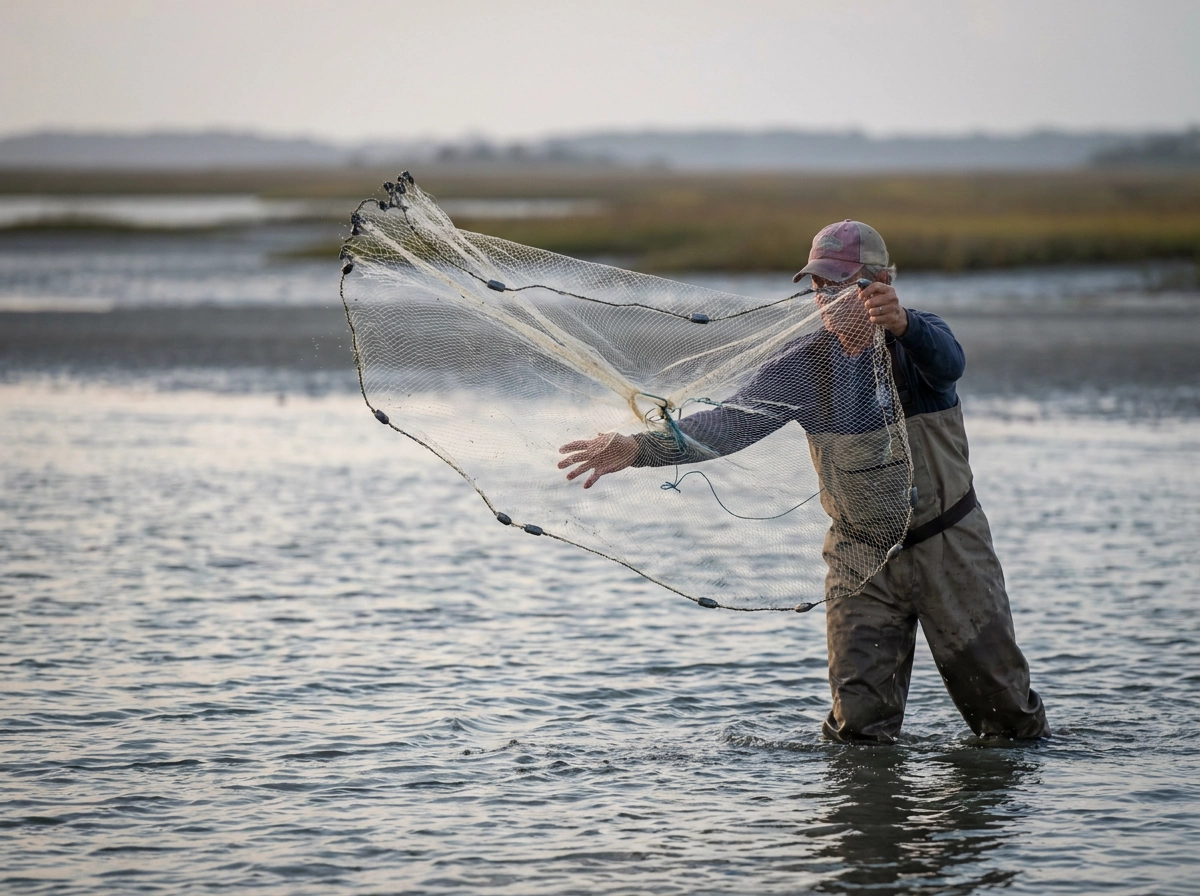
Adjust your throw trajectory first. The standard overhead cast works well for baitfish suspended in the water column, but flounder are on the bottom. A high-arc throw wastes hang time and can cause the net to partially collapse before the lead line reaches the substrate. Instead, use a low, wide release that sends the net out nearly horizontal, prioritizing spread over height. The goal is maximum diameter coverage at the moment the lead line contacts the sand.
Identify the fish before you throw. Scan the bottom just inside and just outside the light cone. A flounder holding on the flat is easy to miss because it rarely moves; look for the flat, diamond-shaped outline with two eyes visible above the sand. The dorsal ridge and gill plate are usually the only features that break the bottom pattern. Resist the urge to throw the moment you see movement. Confirm the silhouette, track the fish for a few seconds, and commit to a clean throw rather than a reactive one.
Aim past the fish, not at it. Throw so the far edge of the net lands just beyond the flounder. As the lead line settles outward and downward, it closes over the fish. A throw aimed directly at the target frequently lands short because the fish will back away slightly from the incoming shadow.
Retrieve fast. Pull the hand line quickly and smoothly to cinch the lead line shut. Flounder's flat profile lets them slide under a slowly closing perimeter with almost no effort. A firm, continuous pull eliminates that gap before they can use it.
Shake before you lift. Once the lead line is closed, shake the net horizontally in the water a few times to work fish toward the center. This prevents flounder from flopping free through the mesh as you bring the net to the surface.
Practice in daylight before your first night trip. A throwing motion you can execute without thinking is worth far more after dark than technical knowledge you cannot apply under pressure. Ten throws in calm, shallow water on a sunny afternoon will do more for your success rate than any amount of pre-trip reading.
Flounder Fishing Tips: Reading Water Conditions at Night
Executing your throw correctly gets fish in the net; choosing the right night gets fish under the light in the first place. The following observations are based on practitioner experience rather than published research, and conditions will vary by location and season.
Water clarity comes first. Clean, clear water lets your underwater light penetrate the full column and improves both light attraction and your ability to spot flounder on the bottom. Turbid or muddy water weakens light attraction significantly because suspended particles scatter the beam before it can draw baitfish and shrimp into a defined cone. After heavy rain or wind events that stir bottom sediment, wait for clarity to recover before running a night netting session.
Calm conditions outperform rough ones. Wind chop disrupts the light cone at the surface, fragments your view of the bottom, and makes it harder to pick out the flat silhouette of a flounder holding in shallow water. Nights with minimal wind and wave action are consistently more productive.
Tidal movement concentrates fish. When tidal flow is modest, flounder tend to hold in stable locations rather than moving with strong currents. This makes stationary light setups more effective because fish remain within your illuminated zone long enough to present a clean throw.
Reduced ambient light gives your setup an edge. Less natural light on the water makes your artificial light the dominant source on the flat, pulling prey and predators in more effectively.
Fish before the front, not after. Rapidly dropping post-frontal temperatures push flounder off shallow flats. The stable weather window before a cold front arrives keeps conditions consistent and flounder in fishable depth.
For trips where conditions force a change in approach, reviewing your complete types of fishing lures and techniques gives you solid backup options when the cast net conditions do not align.
Legal Considerations for Cast Net Flounder Fishing by State
Once you have favorable conditions locked in, your next obligation before hitting the water is legal compliance. Cast net fishing for flounder is broadly legal across many coastal states for recreational harvest, but regulations vary enough by jurisdiction that assumptions are genuinely dangerous. Some states impose hard restrictions on net mesh size, maximum diameter, or specific methods of take, so verify every detail before you go.
The Federal Layer You Cannot Ignore
NOAA Fisheries manages recreational summer flounder harvest at the federal level through interim final rules that establish catch limits and harvest targets. For 2026 and 2027, NOAA has shifted to a conservation equivalency framework, waiving coastwide federal measures in favor of state- or region-developed regulations, provided states collectively meet federal conservation targets. This means your state sets its own size limits, bag limits, and season dates, but federal oversight still applies. Anglers must check both their state wildlife agency's current rules and applicable NOAA measures before targeting flounder with a net. These two frameworks can conflict, and ignorance of either is not a legal defense.
State-by-State Quick Reference
Florida: Flounder may be taken by cast net for recreational purposes. Size and bag limits subject to current FWC rules apply equally to net-caught fish, the same as rod-and-reel harvest. Verify current Florida Fish and Wildlife Conservation Commission rules before each season, as size or bag limit updates can take effect without broad public notice.
North Carolina: The NC Wildlife Resources Commission publishes annual recreational flounder season announcements that govern open dates and legal methods. Consult the 2026 season announcement directly for method-specific guidance on netting and gigging before fishing any NC waters.
South Carolina: The SC Department of Natural Resources permits cast nets for many saltwater species. Confirm that flounder is included under current regulations, and specifically verify whether any nighttime or artificial-light restrictions apply in your target water body before fishing.
Gulf Coast states (Louisiana, Texas, Mississippi, Alabama): Cast net flounder fishing is generally permitted, but restrictions on commercial versus recreational use, minimum mesh sizes, and water body exclusions vary by state and sometimes by specific region within a state. Contact the relevant state wildlife agency for current-year guidance before fishing any new area.
Gigging Is a Separate Legal Category
Do not assume that cast net legality and gigging legality are equivalent in any given state. Gigging, which involves spearing flounder with a multi-tined gig, is regulated separately from netting in most jurisdictions. Some states permit it freely; others impose seasonal closures, gear restrictions, or require a separate license endorsement. If you plan to run both methods on the same trip, confirm the legal status of each independently. The same logic applies when selecting gear for any freshwater application; the breakdown in our guide to catfish net types, specs, and how to choose illustrates how method-specific regulations shape gear selection across different fisheries.
Safety and Best Practices for Night Cast Netting in Saltwater
Regulations protect your catch; the following practices protect you.
Wade with a partner on unfamiliar flats at night. Oyster beds, submerged structure, and sudden drop-offs are nearly impossible to read in low light. A second angler provides immediate assistance if a wading accident occurs, and that margin matters quickly in tidal water.
Wear a lightweight inflatable PFD. Flounder flats that border channel edges can carry deceptively strong tidal flow. A slim inflatable PFD adds critical safety margin without restricting your throwing motion, and it adds almost no bulk over wading gear.
File a float plan before every trip. Give someone onshore your launch location, target flat, and expected return time. Carry a fully charged phone or a VHF radio so you can report changed conditions or call for help if needed. A dead phone on a remote flat at midnight is a serious problem.
Make yourself visible to boat traffic. Waders should carry a waterproof white flashlight and a safety strobe clipped to their PFD or chest. Boats must display proper running lights from sunset to sunrise per U.S. Coast Guard navigation rules; non-compliant lighting is a violation, not just a courtesy issue. Review your tips for effective use of cast nets before your first night session, including how to position yourself safely relative to your vessel or wading partner.
Handle flounder carefully when clearing the net. Their dorsal spines can puncture skin even when the fish appears immobilized. Use a fish gripping tool or a wet glove to remove flounder from the mesh. If you are keeping fish for the table, dispatch them promptly rather than leaving them active in a net where a spine strike is more likely.
Troubleshooting Common Problems with Net Fishing for Flounder
Even with safe gear practices in place, technique problems will cost you fish. Here are the five most common issues and how to fix them.
Fish spooking before the net lands. The culprit is almost always footstep vibration. Shallow water transmits pressure waves efficiently, and flounder detect them through their lateral line. Shorten your final approach by several feet and slow your last two or three steps to a near-crawl before initiating the throw.
Net not opening fully. In water under three feet, the net does not have enough fall distance to open on its own. The fix is in your hands, not the net. Open your throwing hand wider and release fractionally earlier than you would when netting baitfish in deeper water. Most anglers who struggle with this blame net quality; the actual problem is release timing.
No flounder visible despite active baitfish under the light. Flounder are ambush predators that hold along structure transitions, not open flats. Georgia DNR research confirms they favor dock pilings, shell beds, and sharp-sloping depth transitions as primary habitat. If you are working open, featureless water, relocate to a flat-to-depth edge. Flounder will not move far from that structural cover even when baitfish are present directly overhead.
Fish escaping under the lead line on retrieval. This points to insufficient lead weight for the bottom type. Hard sand and shell substrate requires a heavier perimeter to seal quickly. Pull the hand line faster on retrieval, or switch to a heavier-weighted configuration. BasicGear cast nets are available in configurations suited to different bottom types and water depths.
Net tangling or fouling on the throw. Saltwater grass and debris pack into the lead line and prevent even deployment. Rinse your net and hang it to dry after every trip. Before each throw, run your hand along the lead line and clear any grass buildup.
Start Targeting Flounder After Dark
Once you have worked through the troubleshooting, the technique is ready to use. Night cast netting for flounder remains one of the most underused methods in coastal fishing, and anglers who apply it correctly on productive flats will consistently outperform rod-and-reel approaches during the same window of time.
Quick reference before you go:
Net specs: As covered above, target 3/8- to 1/2-inch mesh monofilament, 8 to 12 feet in diameter
Light deployment: As covered above, give your light adequate soak time before your first throw
Positioning: As covered above, work flat-to-depth transitions, not open featureless water
Regulations: Confirm current state wildlife agency rules and applicable NOAA federal measures; verify artificial light restrictions for your specific water body; measure every flounder before it goes in the cooler
Gear quality is a real variable here. A net with uneven lead distribution or a compromised lead line will gap at the bottom at the exact moment it needs to seal, and flounder will use that gap. BasicGear's cast nets are designed for a consistent sink profile and even lead weighting, addressing both failure points directly. With over 100,000 cast nets sold and multiple Amazon best seller rankings, they are a field-tested option for serious saltwater anglers who cannot afford equipment failure on a productive flat at midnight.
The fish are there at night. Now you have the method to reach them.
Conclusion
Night flounder netting rewards preparation, patience, and the right equipment. Deploy your light early, work structure transitions instead of open flats, use a properly weighted monofilament net with a consistent sink profile, and confirm your local regulations before every trip.
The method works because it puts your gear where the fish already are, not where you hope they might wander. Flounder stack on those shallow flat edges after dark, and a well-executed cast net throw covers more productive bottom than hours of rod and reel fishing ever could.
Now take that knowledge to the water. Pick your flat, set your light, and make your first throw with confidence. The technique is proven; the fish are waiting.
Keep reading