Crab Trap Selection Guide: Which Design Works Best for Blue Crab, Dungeness, and Stone Crab
AI-generated header image for: Crab Trap Selection Guide: Which Design Works Best for Blue Crab, Dungeness, and Stone Crab
Every year, anglers drop perfectly functional crab traps into productive water and haul them back empty. The trap was not defective. The bait was not wrong. The problem was simpler and more expensive: the trap was designed for a different species entirely.
Blue crab, Dungeness, and stone crab do not behave the same way underwater, and they do not respond to the same trap geometry. Each species has distinct movement patterns, habitat preferences, and behavioral triggers that translate directly into specific design requirements around funnel count, mesh gauge, frame rigidity, and entrance configuration. Research confirms these differences are measurable. Reducing trap entrances from three to one improves catch efficiency by 24%, and yellow netting outperforms green netting by 31% in swimming crab applications. Getting the specifications right is not a minor refinement; it is the difference between a productive set and an expensive bait donation.
This guide breaks down the biology of each target species, maps those biological realities to specific trap designs, and gives you a practical specification reference so you can purchase with confidence before your next trip.
Why One Trap Does Not Catch All Species
Crab traps are purpose-built tools, not interchangeable hardware. Species behavior, habitat depth, and retrieval method each impose specific requirements on trap geometry, and a mismatch between trap design and target species means you are effectively feeding crabs rather than catching them.
The clearest example of this is the difference between blue crab and stone crab. Blue crab (Callinectes sapidus) swims laterally through the water column using a sculling motion, approaching a trap from the side. A trap built around that entry vector will produce poor results for stone crab, which walks along hard-bottom substrate and approaches bait at floor level. The same entrance angle, mesh geometry, and funnel height that works for one species actively discourages the other.
Mesh gauge compounds the problem from a regulatory direction. Too-coarse wire lets legal-size animals escape before the trap is pulled; too-fine mesh retains undersized crabs that consume your bait, stress larger animals already in the trap, and create measurable regulatory exposure under NOAA commercial fisheries standards. In Louisiana, the sublegal tolerance is capped at 10%, meaning a poorly gauged trap is not just inefficient but a compliance liability.
Funnel count and entrance orientation are where most buyers make their first expensive mistake. Research on swimming crab traps shows that reducing entrance numbers from three to one improves catch efficiency by 24%. More openings do not equal more crabs; the geometry of how a species approaches the trap determines which configuration actually converts interest into capture.
Understanding species-to-trap mapping before purchase is the single highest-leverage fishing tip available to recreational and light-commercial crabbers. It is also foundational gear knowledge covered in resources like this breakdown of essential fishing tools every serious angler should own. The sections that follow apply that mapping to blue crab, Dungeness, and stone crab specifically.
Blue Crab Biology and What It Demands from a Trap
Blue crab (Callinectes sapidus) is the right starting point because its biology is more demanding than most anglers expect, and those demands translate directly into trap specifications.
Habitat range shifts your deployment zone seasonally. Blue crabs require both inshore brackish water and high-salinity ocean environments to complete their life cycle. Females migrate to higher-salinity spawning grounds in lower estuaries and nearshore zones after mating in low-salinity shallows. That means trap placement that produces in spring may go cold by late summer without repositioning, and your rigging setup needs to accommodate both inshore grass flats and harder nearshore conditions.
Size dimorphism controls your mesh selection. Male blue crabs reach 7 to 8 inches across the carapace, occasionally 10 inches. Females run smaller and are identifiable by a rounded abdomen, compared to the T-shaped abdomen of males. Mesh gauge must retain legal-size males while allowing smaller females to exit without injury. Getting this wrong in either direction creates regulatory exposure or depletes the females that sustain the population.
Swimming mechanics dictate funnel geometry. Blue crabs propel themselves by sculling their fifth pair of oar-like legs at 20 to 40 revolutions per minute, generating a distinctly lateral approach rather than a head-on entry. Funnel entrances oriented to intercept that sideways movement path outperform forward-facing designs for this species specifically.
Regulatory environment varies by region. The Chesapeake Bay, North Carolina, and Louisiana host the largest U.S. blue crab fisheries, and each carries localized trap regulations governing funnel count, escape ring placement, and minimum carapace size. Before purchasing any trap, verify current state specifications for your target fishery.
Molt timing affects soak strategy. The smallest crabs shed every 3 to 5 days, juveniles every 10 to 14 days, and crabs 3 inches or larger every 20 to 50 days. Deploying traps during peak molt windows fills your bait chamber and empties your catch bag. For a full walkthrough of deployment logistics, see how to set up your crab trap before your first set.
Best Trap Design for Blue Crab: Geometry, Funnel Count, and Mesh
That lateral swimming approach maps directly to a specific trap geometry: a rigid vinyl-coated wire box trap, typically 24 x 24 inches, with two opposing side funnels. This configuration dominates Atlantic and Gulf Coast fisheries because the side-entry orientation intercepts blue crab moving laterally rather than forcing a perpendicular approach.
Funnel count is where many buyers go wrong. The instinct to maximize entry points works against you. Peer-reviewed research confirms that reducing entrance count from three to one improves catch efficiency by 24%. Two opposing funnels apply that logic while preserving bilateral approach coverage. Avoid three- and four-funnel designs for blue crab.
Entrance netting color is an underutilized variable. Yellow netting outperforms green by 31% in swimming crab traps, and at 45 meters or less, yellow entrance traps produce 33% more catch than the same design set deeper. Since nearly all inshore blue crab habitat falls within that depth range, yellow netting is a practical, measurable upgrade over standard green mesh.
Mesh gauge determines what stays in the trap. A 1.5 to 2-inch hexagonal wire mesh retains legal-size animals (typically 5 inches point-to-point across most states) while letting juveniles escape through the bait chamber walls. NOAA-affiliated research confirms that 1.5-inch hexagonal mesh maximizes legal catch and minimizes sublegal retention in Gulf Coast estuaries.
For kayak or small-skiff anglers, collapsible vinyl-coated wire traps fold flat for transport when deck space is limited. The critical requirement: the frame must lock fully rigid before deployment. A partially collapsed trap shifts funnel alignment under tidal current and negates every other specification advantage.
How trap geometry interacts with rigging and line setup connects to broader gear decisions covered in this complete guide to fishing nets and net types, which addresses mesh materials and configurations across multiple fishing applications.
Dungeness Crab Biology and Habitat Considerations
Shifting focus from the Atlantic and Gulf Coast to the Pacific reveals a fundamentally different crabbing target. Dungeness crab (Metacarcinus magister) occupies sandy and muddy bottom zones from intertidal flats to depths exceeding 750 feet, but recreational effort concentrates between 30 and 180 feet along the Pacific Coast, where population density is highest.
Benthic movement changes everything about trap entry design. Dungeness are classified as highly motile benthic invertebrates; they move along the seafloor, not through the water column. That single behavioral distinction shifts the design priority away from mid-water funnel alignment and toward bottom-oriented or lower-side entrance placement. A trap configured for a swimming crab's lateral mid-column approach is structurally mismatched to a species that approaches from the substrate up.
Size is the next critical variable. Legal males measure at least 5.75 inches across the carapace in most West Coast states, making them significantly larger than harvestable blue crab. A funnel throat sized for blue crab creates entry resistance at the carapace shoulders of a legal Dungeness, pushing crabs away rather than guiding them in. Heavier wire gauge also becomes necessary; lighter mesh deforms under the physical load of larger animals over multi-day soaks.
In-trap congestion is a documented yield problem with Dungeness specifically. Overcrowded traps produce cannibalism and in-trap mortality, which reduces net catch and degrades bait. This behavior makes larger internal trap volume and wider escape port placement functional requirements, not optional upgrades.
Regulatory compliance adds another layer to trap selection. NOAA's List of Fisheries formally recognizes the California Dungeness crab pot fishery under the Marine Mammal Protection Act, and required escape port dimensions, seasonal deployment windows, and trap specifications vary by state across California, Oregon, and Washington. Buying a trap that does not meet your state's current escape port standard means the gear is non-compliant before it hits the water.
Best Trap Design for Dungeness Crab: Round Pots, Ring Nets, and Rigid Frames
Those behavioral and habitat realities translate directly into trap geometry choices, and getting the hardware right determines whether you pull Dungeness or pull empty wire.
Rigid pots are the primary tool. Round or octagonal rigid wire pots ranging from 24 to 36 inches in diameter give Dungeness the internal volume they need. More space means less crowding, and less crowding means fewer crabs lost to cannibalism before retrieval. The wide, stable base holds position on sandy and rocky Pacific seafloor where current and surge can shift lighter traps off-target.
Ring nets and pyramid traps fill the recreational gap. For pier or kayak crabbers, collapsible ring nets and pyramid-style traps deploy fast, retrieve easily, and store flat. The trade-off is containment: a Dungeness investigating bait on a ring net can simply walk off the edge. Pulls every 15 to 30 minutes are necessary to convert interest into catch. These designs reward active attention, not passive soaking.
Mesh gauge controls legal compliance. Use a minimum 1.75-inch square mesh or 2-inch hexagonal wire. Either opening lets undersized crabs exit freely while retaining legal males above the 5.75-inch carapace threshold. Tighter mesh traps juveniles that consume bait, crowd the pot, and create regulatory risk.
Bait containment is non-negotiable. Dungeness will strip loosely clipped bait from outside the trap before committing to entry. A perforated bait jar or sealed bait cage disperses scent continuously without letting crabs feed from the exterior. Open clips give away the catch incentive too early.
Escape ports do double duty. Properly sized escape ports, typically 4.25 x 1.75 inches under many West Coast regulations, satisfy legal requirements and prevent in-trap overcrowding that suppresses catch rates across subsequent sets. The same principle applies across different fisheries, including freshwater gear decisions covered in guides like this breakdown of catfish net types and specs, where containment geometry similarly drives outcomes.
Stone Crab Biology and the Unique Challenge of Claw-Focused Harvest
Stone crab (Menippe mercenaria) operates on fundamentally different terms than either blue crab or Dungeness, and those differences start with the harvest method itself. Fishers remove one or both claws and return the crab alive to regenerate, which means the trap's entire job is capture and containment without claw damage. A trap that stresses or injures the animal destroys the only part of it with commercial value.
The species is a bottom dweller in the strictest sense. Stone crabs occupy hard-bottom reef structures, oyster bars, and rocky substrate from shallow nearshore flats down to roughly 180 feet along the Florida coast and into the Gulf of Mexico. They burrow and hold position in structure rather than ranging through the water column.
The stone crab trap fishery carries formal federal standing under NOAA's Marine Mammal Protection Act List of Fisheries, which subjects it to standardized gear specifications and distinguishes it from informal recreational crabbing. That regulatory recognition matters for trap selection because any pot deployed commercially must meet documented dimension and configuration standards, not just catch crabs effectively.
Stone crabs do not swim. They walk along structure, which invalidates any trap design engineered around mid-water funnel placement or current-aided entry. A side funnel positioned at mid-frame height requires the crab to climb to enter; stone crabs will not reliably do that.
Effective trap entry for this species depends on scent dispersal at substrate level and funnel geometry positioned at or near the trap floor. Because stone crabs locate bait through chemoreception while moving along the bottom, entrances placed low capture that approach vector directly. Elevated funnels simply miss most of the traffic. Choosing the right fishing bait and understanding how scent dispersal works is especially consequential for stone crab, where bait positioning within the trap determines whether the scent trail ever reaches the crab's path along the substrate.
Best Trap Design for Stone Crab: Rigid Pots, Floor Funnels, and Durability Standards
That substrate-walking behavior dictates every aspect of the correct trap specification.
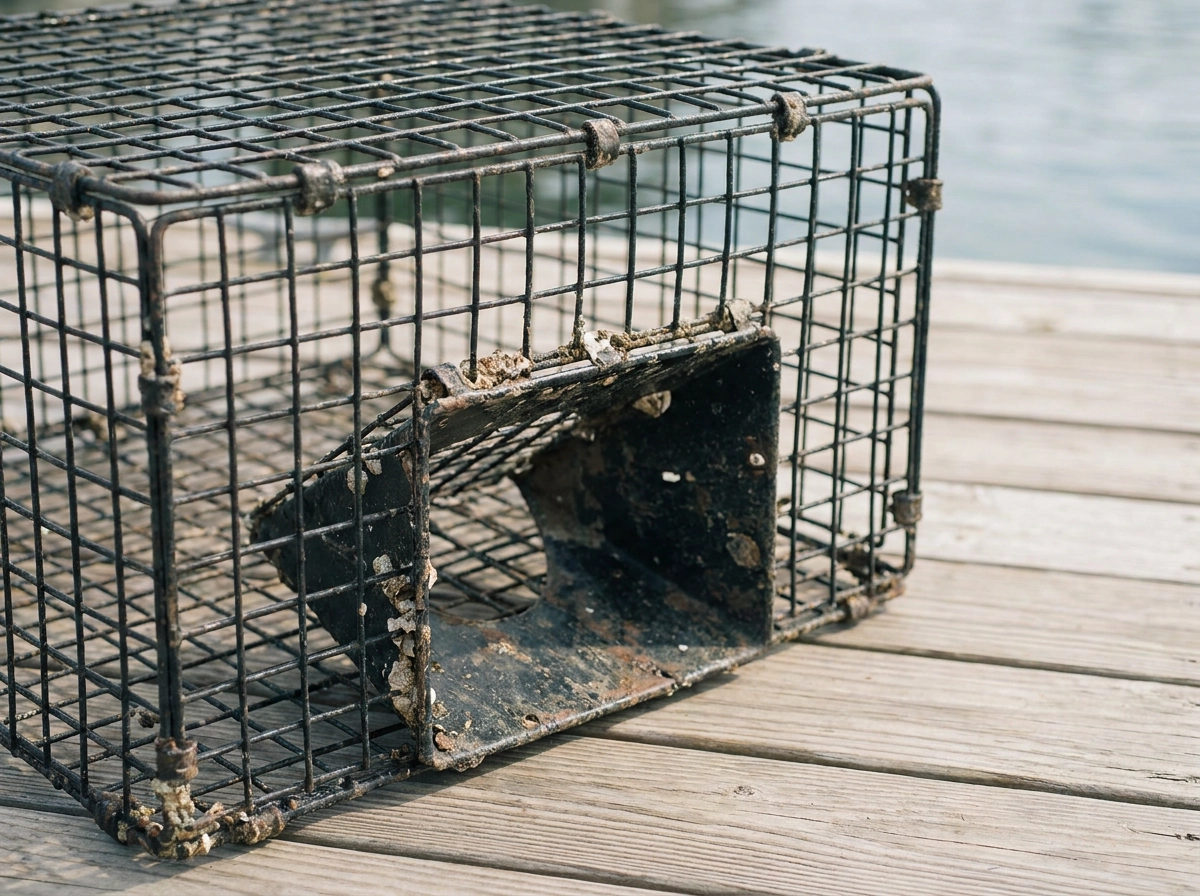
The standard commercial design is a rigid vinyl-coated wire pot, typically 22 x 22 x 12 inches, with bottom-oriented or angled lower-side funnel entrances. The low-profile dimensions keep the trap flush against hard-bottom and reef structure, and the floor-level funnels align directly with the crab's walking approach. No climbing required, no mid-water entry angle to miss.
Collapsible traps are a poor match for this fishery. Hard-bottom reef habitats generate significant abrasion and structural stress during soak periods, and any deformation to a collapsible frame shifts funnel alignment enough to allow catch to escape or prevent entry entirely. Stone crab traps can soak up to 10 days before season opens, then remain deployed through the full season. That extended exposure demands a frame that holds its geometry without supervision.
Wire gauge is not a place to compromise. Minimum 14-gauge vinyl-coated wire with 2-inch mesh is the functional threshold for stone crab applications. Lighter gauge mesh degrades faster against abrasive substrate and is vulnerable to damage from the stone crab's powerful claws across repeated sets. Coated wire resists corrosion in saltwater reef environments where uncoated mesh would fail within a single season.
Bait chamber design follows the same logic as funnel placement. Stone crabs use chemoreception to locate food at substrate level, so bait placed in a secure enclosed compartment near the trap floor produces better entry rates than open bait clips. Enclosed chambers also prevent the crab from stripping bait from outside the trap before entering.
Regulatory compliance is a functional requirement, not a formality. NOAA and the Florida Fish and Wildlife Conservation Commission govern stone crab trap specifications jointly, including maximum trap dimensions (no larger than 2 x 2 x 2 feet), required escape gaps, and the current minimum claw size of 2 7/8 inches. Verify your trap against current FWC specifications before any deployment.
Collapsible vs. Rigid Crab Traps: Which Frame Style Fits Your Fishery
The choice between collapsible and rigid frames cuts across all three species covered above, and it is worth addressing directly before moving into entrance geometry.
Rigid wire traps hold funnel alignment under load. Tidal current and sustained bottom pressure can deform a collapsible frame enough to shift entrance angles off their designed orientation. That misalignment reduces catch efficiency regardless of how well the rest of the trap is configured. For blue crab and stone crab, where traps may soak overnight or across multiple days, frame integrity is not optional. Debris accumulation, current drag, and the weight of trapped crabs compound over time; rigid coated-wire construction absorbs that load without geometry loss.
Collapsible traps solve a real problem for recreational anglers. Flat storage, lighter carry weight, and the ability to fit a half-dozen traps into a truck bed or kayak hatch are genuine advantages. The trade-off is pre-deployment discipline: every collapsible trap must be fully locked into frame before it hits the water. A partially set frame fishes like a defective trap, and the problem is invisible once the trap is on the bottom.
Soak time is the clearest decision variable. Multi-day sets demand rigid construction. For Dungeness ring-net fishing from a pier or kayak, where retrieval happens every 15 to 30 minutes and the trap is never unattended, collapsible designs perform adequately because the structural compromise never accumulates.
On cost, collapsible traps are cheaper upfront but wear faster in high-abrasion environments like stone crab reef habitat. Rigid vinyl-coated traps carry a higher purchase price and lower cost per season for anyone making consistent sets.
Keeping the right trap functional also means keeping the right tools on hand; a quality fishing multi tool built for saltwater handles the wire cuts and rigging adjustments that come with deploying and maintaining rigid-frame pots across a full season.
Funnel Count, Mesh Gauge, and Entrance Color: The Variables That Actually Move the Needle
Frame style determines whether your trap stays functional in the water. These three variables determine whether it actually catches legal-size crab once it does.
Funnel count is the most misunderstood specification in recreational trap buying. More openings feels like more opportunity, but peer-reviewed research on swimming crab traps found that a single-entrance design outperformed three-entrance configurations by 24% in catch efficiency. Additional funnels create competing entry signals that disrupt the crab's approach path. Two opposing side funnels work for blue crab; bottom-oriented single or dual funnels for stone crab.
Mesh gauge sets the size floor for every crab your trap retains. Hexagonal 1.5-inch wire is the NOAA-validated specification for blue crab, calibrated to retain legal males above the 5-inch point-to-point minimum while allowing juvenile exit. Dungeness and stone crab require 2-inch or larger mesh; undersized animals that cannot escape die, foul the bait, and suppress entry by legal-size targets. For a full mesh size reference table across species and wire configurations, consult BasicGear's sizing guide.
Entrance netting color is almost universally ignored. Yellow netting outperforms green by 31% in swimming crab catch rates, growing to 33% in water at 45 meters or less, the range covering nearly all inshore blue crab habitat. That is a measurable yield difference from a single component swap.
Funnel throat diameter must be species-calibrated. Blue crab funnels run 3 to 4 inches, accommodating angled lateral entry of a 7 to 8-inch shell. Dungeness require 5 to 6 inches; a narrower throat creates resistance at the carapace shoulder that turns legal males away before entry.
Escape ports satisfy legal requirements across most blue crab and Dungeness states and extend the function of mesh gauge. Even correctly gauged mesh allows some undersized crabs to become wedged. Without a functional escape route, those animals die under stress, degrading bait quality and reducing attractiveness to the size-class you are targeting.
Bait-Holding Design and Deployment Tips That Apply Across All Three Species
Trap geometry and mesh gauge determine whether crabs enter. Bait design determines whether they stay long enough to be caught.
How you contain bait matters more than what bait you use. A perforated bait jar or enclosed bait cage disperses scent through the water column continuously without allowing crabs to feed from outside the trap. That distinction is critical: a crab that can pick bait through open mesh or an unsecured clip has no reason to push through a funnel. Most empty traps pulled from well-baited sets fail at containment, not at attractant selection.
Blue crab respond strongly to oily, high-scent baits. Menhaden, mullet, and chicken necks are proven attractants, with research confirming that menhaden-derived scent compounds directly stimulate alerting and grabbing behavior. Place bait in a vented box centered on the trap floor and secure it. In tidal current, loose bait clips allow displacement that collapses your scent cone and pulls it outside the trap entirely.
Dungeness crab require fresh bait with aggressive scent output. Squid, clams, and fresh fish carcasses consistently outperform processed or aged alternatives. Because scent dispersal degrades with bait condition, replace bait every 24 to 48 hours during active soak periods. A sealed bait jar with perforations sized to release scent without exposing the bait surface is the most efficient containment format for Dungeness sets.
Stone crab locate food almost entirely through substrate-level chemoreception. Bait placed high in the trap, on a center-elevated mount or upper wire, sits above the crab's primary detection zone. Position bait at or near the trap floor to align with the species' bottom-up approach.
One practical strategy for cutting bait costs across all three species: pair your trap deployment with a cast net and harvest baitfish on-site. Fresh-caught baitfish deployed immediately outperform store-bought alternatives in scent output and crab response. This crossover between net fishing and trap fishing is one of the more underused fishing tips for anglers who also target species like catfish, where fresh versus processed bait produces similarly measurable differences in catch rate.
Species-to-Trap Specification Quick Reference
With bait strategy covered, the table below consolidates every specification discussed in this guide into a single purchase-decision reference.
Specification | Blue Crab | Dungeness | Stone Crab |
|---|---|---|---|
Frame type | Rigid box | Rigid round/octagonal pot or collapsible ring net | Rigid pot only |
Dimensions | 24 x 24 in | 24–36 in diameter | 22 x 22 x 12 in |
Wire gauge | Standard vinyl-coated | Standard vinyl-coated | 14-gauge minimum, vinyl-coated |
Mesh size | 1.5–2 in hexagonal | 2 in minimum | 2 in minimum |
Funnel placement | Two opposing side funnels | Floor-level or lower-side | Bottom-oriented |
Entrance netting | Yellow | Standard | Standard |
Bait containment | Enclosed vented bait box | Sealed bait jar | Enclosed compartment, floor-level |
Deployment depth | Inshore to nearshore | 30–180 ft | Nearshore hard bottom |
Soak duration | Multi-day capable (rigid) | Short pulls for ring nets; multi-day for rigid pots | Multi-day (rigid required) |
Frame type is the non-negotiable variable. Collapsible traps are acceptable for recreational blue crab fishing and Dungeness ring-net applications where retrieval is frequent. Stone crab fisheries require rigid frames without exception; hard-bottom habitat and multi-day soaks will deform any collapsible design, compromising funnel alignment and catch retention.
BasicGear's crab trap line is built to rigid-frame specification using vinyl-coated wire, which satisfies the durability threshold for both blue crab and stone crab environments. Before purchasing, cross-reference current product specs against your target state's trap dimension limits, escape ring requirements, and mesh minimums. Regulations vary by state and season, and a trap that exceeds allowable dimensions creates legal exposure regardless of how well it performs.
Match the Trap to the Species, Not the Other Way Around
The quick-reference table above maps the specifications. What it cannot enforce is the purchase decision that follows.
Three principles cut across every species in this guide. First, reduce blue crab funnel count to two opposing side funnels rather than defaulting to four-funnel designs; research on swimming crab traps confirms a streamlined entrance configuration outperforms the instinct to maximize openings. Second, use yellow netting entrance inserts for any shallow-water deployment; the 31% catch-rate advantage over green netting, and the additional 33% gain at depths of 45 meters and under, is measurable enough to treat as a standard setup step rather than an optional upgrade. Third, match wire gauge to habitat abrasion, not just species size; a 12-gauge coated wire that handles a stone crab's claws will also outlast a lighter gauge against oyster bars and reef structure across multiple seasons.
Before finalizing any trap purchase, verify your target state's current specifications. Carapace minimums, escape ring dimensions, and allowable trap sizes vary by state and sometimes by zone within a state. Regulatory non-compliance turns a well-built trap into a liability regardless of how well it performs.
One addition that pays dividends across all three species: pair your trap setup with a cast net for on-site bait harvesting. Fresh-caught menhaden, mullet, or local baitfish deployed immediately outperform processed alternatives on scent dispersal and holding power inside a bait chamber. The cast net reduces ongoing bait cost while consistently improving entry rates.
Gear matched to species behavior does more than increase catch counts. It shortens productive soak time, extends bait life between pulls, and produces a higher proportion of legal-size animals per set. That efficiency compounds across a full season.
Conclusion
Species biology, trap geometry, and habitat conditions are not separate considerations; they are a single system. Blue crab demands wide-mouth funnels and rectangular frames. Dungeness rewards round pots with controlled entry points. Stone crab requires floor funnels, rigid construction, and materials tough enough to survive repeated claw contact.
The traps that consistently produce legal-size animals share three traits: entrance geometry matched to target behavior, wire gauge suited to the specific bottom structure, and bait chambers designed to hold scent through a full soak cycle.
Start by auditing your current setup against the species-specific specifications in this guide. Identify the one or two variables furthest from optimal and adjust those first. Small, deliberate changes to trap design compound into measurable gains across a full season. Match the trap to the species, and the catch will follow.
Keep reading