Best Fillet Knife for Saltwater Fish: What Changes When You're Cleaning Redfish, Flounder, and Snook
AI-generated header image for: Best Fillet Knife for Saltwater Fish: What Changes When You're Cleaning Redfish, Flounder, and Snook
Saltwater fishing is unforgiving, and your fillet knife should be built the same way. The moment you start cleaning redfish on a wet dock, working through flounder's flat anatomy, or navigating snook's dense rib cage, it becomes obvious that a standard freshwater knife simply was not designed for this work. Salt accelerates corrosion, hard scales dull inferior steel faster than you'd expect, and wet hands in a marine environment turn a poorly designed handle into a liability.
Choosing the best fillet knife for saltwater fish is not a matter of personal preference. It is a specification decision. Blade length, steel composition, flex rating, and handle material all need to match the specific demands of the species you're targeting and the conditions you're working in.
This guide breaks down exactly how those specifications translate to real performance. You will learn how steel type determines long-term corrosion resistance, how blade length and flex align with specific saltwater species, and how to build a complete fillet setup that holds up across an entire season. Every section moves from principle to practical recommendation, giving you a precise framework for making the right call.
Why Saltwater Fishing Demands a Different Knife Entirely
Salt doesn't forgive cheap steel. A standard stainless blade that performs fine on a freshwater walleye degrades faster in a chloride-rich environment than it ever would on a freshwater dock. The saltwater environment is categorically more aggressive than anything a freshwater knife encounters, and the steel grade in your blade determines whether it survives that exposure or becomes a rust-streaked liability by mid-summer.
The fish themselves compound the problem. Redfish carry hard, armor-like scales that deflect a high-flex blade instead of letting it seat cleanly behind the gill plate. Flounder present a flat bilateral skeleton that requires the blade to track laterally along a horizontal spine, a geometry that punishes both over-flex and rigidity. Snook have a dense, curved rib cage that demands a controlled two-pass technique. These three species alone represent three distinct blade geometry problems, and none of them respond well to the same knife.
A freshwater walleye knife illustrates the mismatch directly. That 6 to 7-inch high-flex profile, perfectly suited for soft-scaled freshwater fish, skates across a redfish flank rather than biting through. The blade deflects under lateral pressure instead of maintaining entry angle. You lose control, you lose meat, and you risk the blade tracking toward your hand.
The dock environment layers in additional demands. Slimy wet hands, a boat shifting under your feet, and a cramped cleaning station turn grip design from a comfort consideration into a genuine safety specification. A smooth polymer handle that feels fine in a tackle shop becomes a hazard the moment it's coated in snook slime.
The best fillet knife for saltwater fish is defined by three specs that experienced saltwater anglers consistently prioritize: corrosion-resistant high-carbon stainless steel, a blade length of 7 to 9 inches, and a medium-flex profile. Every other variable is secondary to getting those three right. If you want a complete breakdown of how each spec translates to performance at the cleaning table, this guide to fish fillet knife selection covers every technical variable worth understanding before you buy.
Steel Type Is Not Optional in Salt: High-Carbon Stainless Explained
Standard stainless steel is the default material in budget and mid-range knives, and it handles surface rust adequately. The problem is edge retention. Under the repeated lateral pressure of long fillet strokes on large inshore species, standard stainless dulls faster than the work demands. You notice it mid-fillet on a bull red, not after the trip.
High-carbon stainless steel, most commonly designated 420HC, is the practical answer. Grade 420 stainless is a high-carbon alloy with a minimum 12% chromium content, giving it corrosion resistance alongside the hardness needed to hold a working edge through a full day of saltwater cleaning. It is the alloy compromise that survives the environment without constantly needing a sharpening stone. If you are researching what makes one blade outperform another, the fillet knife selection guide at BasicGear covers how steel designation translates to real-world performance.
Pure high-carbon steel (non-stainless) holds a sharper initial edge than any stainless variant. In a saltwater context, that advantage disappears fast. Salt is aggressively corrosive to unprotected carbon steel; rinsing and drying after every single use is not a best practice, it is a maintenance requirement. Skip it once and the corrosion starts at micro-scratch sites across the blade face.
Full-tang construction closes a specific failure point by running the steel continuously from blade tip through the full length of the handle, leaving no joint where moisture can pool.
Blade Length and Flex: The Spec Chart That Actually Matches Species
Steel quality determines how long your edge lasts. Blade geometry determines whether that edge can do its job in the first place.
4 to 6 inch blades cover trout, panfish, and small inshore species adequately. They're functional on flounder under a pound, but any fish requiring a full lateral stroke exposes the core limitation: the blade runs out of length mid-fillet, forcing a repositioning that leaves a seam in the meat and costs yield.
7 inch blades with medium flex are the professional standard. A single lateral stroke covers most slot-size redfish and snook without repositioning. The flex allows the blade to track around rib structures rather than punching through them, which protects both the fillet and the edge. This is the spec that serious inshore anglers and bass fishing gear specialists alike keep as their go-to workhorse blade, regardless of target species.
9 inch blades address the upper end of the inshore range: bull reds, large snapper, and fish where a 7 inch blade requires two passes. Two passes mean a seam. On a 30-inch redfish, that seam runs through the thickest, most valuable part of the fillet.
Medium flex is the critical variable for multi-species saltwater use. A fully flexible blade deflects off redfish scales instead of biting through them, losing the entry angle before the stroke begins. A stiff blade fails on flounder, riding up off the flat skeletal structure and wasting the belly meat. Medium flex holds a controlled arc in both situations.
Redfish: Why Hard Scales and Thick Skin Require a Specific Entry Angle
Redfish present the first real stress test for spec decisions made on paper. Their scales are large, jagged, and notably hard and rough-edged compared to softer-scaled inshore fish, which means a blade with too much flex doesn't bite cleanly behind the gill plate. It deflects. The result is a skating entry that damages the flesh before the lateral stroke even begins.
Entry angle is everything on redfish. The blade tip needs to be stiff enough to seat firmly behind the leading scale edge before the stroke transitions laterally. A sharp initial bevel drives that seating cut; without it, the tip rides over the scale rather than under it. Medium flex outperforms both extremes here: the spine provides the resistance needed for entry, while the tip retains just enough give to angle down and lock in.
Blade length directly affects meat yield. A blade shorter than 7 inches forces at least one mid-fillet repositioning on larger slot fish. Every repositioning is a new entry point and a new opportunity to drift into the ribcage. A single continuous lateral stroke from a 7-to-9-inch blade eliminates that risk entirely on fish in the slot range.
Skin-on filleting adds a second technical demand. Many anglers fillet redfish skin-on, and that technique requires the blade to run flat along the skin's surface for the full stroke length. A blade with excess flex will let the tip angle upward under light pressure, cutting through rather than beneath the skin. Consistent, flat blade tracking is the only way to protect that skin layer.
A fully rigid blade fails on the back half of a large red, where the body tapers and the spine curves. Without any flex, the blade drags rather than glides, producing an uneven fillet with visible gouges. If you're also removing skin post-fillet, pairing a medium-flex knife with dedicated fish skinner pliers gives you cleaner results than trying to do both jobs with the blade alone.
Flounder Filleting Is a Geometry Problem: How Blade Flex Solves It
Redfish demand stiffness and force at the entry point. Flounder demand the opposite.
Flounder's anatomy is unlike any other common inshore species. The fish lies completely flat, and its skeleton runs laterally rather than vertically, which means the spine is a horizontal rail you track outward in both directions. That structure calls for separate cuts along each side of the lateral spine, but only if the blade stays in contact with the bone throughout the stroke. A stiff blade rides up off the flat spine almost immediately, leaving a thin layer of meat behind. A flexible fillet knife conforms to that bone plane and recovers what a rigid blade wastes.
Skin pressure matters equally here. Flounder skin is thin and tears quickly if you apply redfish-level force. The same blade weight that seats cleanly behind a redfish gill plate will drag and split flounder skin. The technique shift is deliberate: lighter contact, more reliance on tip flex to steer rather than spine pressure to push.
Blade length resolves the geometry. Most inshore flounder fall well within the 7-inch blade's reach. A 7-inch blade covers that lateral stroke in a single pass without overrunning the tail section, where excess length causes tip wander and ragged cuts near the narrowest part of the fillet. Shorter blades require repositioning mid-stroke and leave a seam. Longer blades lose the fine tip control the tail end requires.
This is the species that justifies carrying a flexible fillet knife in a saltwater kit. Flounder punishes insufficient flex more than any other fish in the inshore lineup, and it's regularly caught on the same flats and grass edges where redfish are targeted. The same trip, two different fish, one blade spec that handles both cleanly.
Snook's Rib Cage Is the Hardest Test: Navigating Complex Bone Structure
Flounder punishes a stiff blade; snook punishes an imprecise one. Where flounder demands flex for spine tracking, snook demands technique for rib navigation, and the anatomy makes that distinction critical.
Snook carry a rib cage that requires more deliberate navigation than the other two species covered here. Blind blade navigation through that structure consistently results in nicked ribs and wasted belly meat. The fish demands a deliberate two-pass approach rather than a single lateral stroke.
The Over-and-Under Technique
The first pass runs above the ribs, freeing the top half of the fillet from the spine down to the rib tips. The second pass angles the blade downward and sweeps under those rib tips to recover the belly meat. Skipping the second pass leaves a meaningful portion of the fillet behind, which matters with snook given their harvest restrictions.
Snook are subject to harvest regulations that vary by season and region, check current state rules before keeping one. When you legally keep one that meets size requirements, that fish represents a single-opportunity yield. Maximizing the fillet from both passes is not optional. A good fish hook remover protects the fish during release when harvest is closed, but on legal harvest days, your knife technique determines how much of that fish reaches the table.
Why a 7-Inch Medium-Flex Blade Fits This Work
A 7-inch medium-flex blade handles both passes cleanly. On the lower sweep, the flex allows the blade to arc around the rib curve rather than driving straight through it. A stiff blade snaps against bone; a fully flexible blade loses directional control on the angled entry. Medium flex is the functional middle ground.
Grip Security on a Slippery Fish
Grip security is especially important on snook, see the handle section for specifics.
Handle Design and Grip: What Wet Dock Work Actually Requires
Textured, overmolded, or rubberized grips are non-negotiable for salt environments. Smooth polymer handles that feel adequate in a tackle shop become genuinely hazardous once coated in saltwater and fish slime. The friction disappears. An overmolded handle with raised texture or checkering maintains purchase through the full lateral fillet stroke, regardless of conditions.
Trigger grip geometry adds a specific safety layer. The molded protrusion at the blade-handle junction acts as a physical finger anchor, which matters most when repositioning the blade mid-fillet. Without it, the hand can shift forward toward the edge during the kind of controlled repositioning that snook's two-pass rib technique demands.
Material selection determines how long the handle survives salt exposure. Wood handles absorb saltwater, swell, crack along the grain, and trap bacteria in those cracks. Neither aesthetic appeal nor tradition changes that outcome. Full-synthetic or rubberized handles with sealed joints resist salt degradation across seasons of dock use. This is a durability decision, not a preference.
Handle shape determines fatigue over a multi-fish processing session. A handle contoured for a forward grip, with the thumb naturally angling toward the blade, reduces the wrist rotation required during long lateral strokes on large-body fish. That reduction compounds across a full cooler of redfish.
Full-tang construction also eliminates the internal moisture trap described in the Steel section.
For anglers building a complete saltwater setup, The Complete Fishing Tool Kit: Everything a Serious Angler Needs covers the full range of tools that belong alongside a quality fillet knife on the water.
Salt Kills Blades Fast: The Maintenance Protocol That Extends Knife Life
The right handle keeps the knife in your hand. The right maintenance protocol keeps the blade worth using.
Rinse immediately after every session. Experienced anglers rinse immediately because once brine evaporates off a blade surface, salt residue concentrates at any surface imperfection and begins working on the steel well before anything is visible. Fresh water, right at the dock, before the knife goes anywhere near a bag or sheath.
Dry completely before storage. A damp blade in a sealed sheath is a known corrosion risk. Pat dry, then let the blade air for several minutes before it goes away. This applies to high-carbon stainless steel just as much as lower-grade alloys. The same principle applies to stainless steel fishing pliers, where alloy grade and post-use drying both determine whether the tool survives a full season.
Apply food-safe mineral oil after drying. Mineral oil is a widely used protective wipe that slows oxidation and helps block the surface degradation that dulls an edge before any rust appears. Food-safe formulations are non-toxic on blades that contact fish meat.
Hone with a ceramic rod rather than a honing steel. Many fillet knife users prefer a ceramic rod to avoid over-removing material, since the thin geometry of a fillet blade can lose its bevel profile faster than heavier blades when worked on steel.
Store in a ventilated sheath. A sealed plastic case traps residual humidity against the blade. A vented polymer sheath allows moisture to escape and keeps the edge protected between trips.
Fillet Knife Sheath and Boat Storage: Protecting the Blade Between Trips
Sheath choice extends the maintenance protocol directly into storage. A fillet knife sheath in a saltwater context serves two distinct functions: edge protection, preventing contact damage during transport, and corrosion management, where sheath material and ventilation determine how much moisture stays against the blade.
Hard plastic or molded polymer sheaths with drainage slots are the correct choice for boat storage. They hold the edge off hard surfaces, allow water to drain freely rather than pool, and resist the salt degradation that breaks down softer materials over time. This is the specification that matters when a knife gets rinsed dockside and dropped back into storage wet.
Leather sheaths are the wrong choice for saltwater use, regardless of blade quality. Leather absorbs saltwater and holds it directly against the blade, creating a sealed, damp environment that accelerates pitting corrosion even on high-carbon stainless steel. The traditional appeal of leather does not offset what it costs a blade over a season of regular dock use.
Foldable knife designs offer a different solution entirely. A folding blade eliminates edge-contact risk without requiring a sheath at all, and the reduced footprint fits cleanly into tackle bags and dry boxes where a fixed blade plus sheath takes up more room. For anglers prioritizing compact boat storage, this is a practical alternative worth considering.
Placement on the boat is the final variable. A sheathed knife stored inside a sealed tackle bag traps humidity around the blade, even with a polymer sheath. A rod holder-mounted knife clip or an open-slot position on a tackle tray solves both problems: residual moisture evaporates freely, and the knife is accessible without digging through gear when the next fish hits the deck.
Price Tiers and What You Actually Get: Matching Budget to Saltwater Performance
Proper storage preserves your blade between trips. The right purchase decision determines what you're protecting in the first place.
The $15–20 tier has a defined ceiling. A shorter entry-level knife handles panfish and small inshore species adequately, but it fails on two counts the moment you're cleaning redfish or snook: blade length forces mid-fillet repositioning, and the steel grade dulls faster under the lateral pressure of long strokes on large-bodied fish. For occasional dock use on small catch, it's sufficient. For consistent saltwater performance, it isn't.
The $40–60 range is where serious saltwater anglers should shop. This tier delivers high-carbon stainless steel, full-tang or quality partial-tang construction, 7–9 inch blade options, and synthetic non-slip grip materials. These aren't premium upgrades; they're the baseline specifications this post has outlined as consistently prioritized for redfish, flounder, and snook. The performance at $50 is not a compromise, it's the functional sweet spot where steel quality, blade geometry, and handle design converge.
Above $100, you're buying fit, finish, and brand heritage. A professional-tier knife at $150 offers tighter tolerances and premium materials, differences that are real but narrow in field conditions.
BasicGear's fillet knife lineup is built specifically for the $40–60 performance tier: high-carbon stainless steel blade, ergonomic non-slip handle, and a medium-flex profile in the 7–9 inch range that handles redfish, flounder, and snook without requiring a tool swap.
The real cost of underbuying shows up as meat left behind.
Do You Need One Knife or a Kit? How to Build a Saltwater Fillet Setup
Once you've settled on the right price tier, the next decision is configuration: one knife or two.
For most inshore anglers, a single 7-inch medium-flex knife in high-carbon stainless is the right answer. It handles redfish, flounder, snook, trout, and sheepshead without a species-specific swap. The blade length covers the full lateral stroke on slot-size fish; the medium-flex profile adapts between flounder's flat skeleton and snook's curved ribs. One knife, maintained correctly, covers the entire inshore species list.
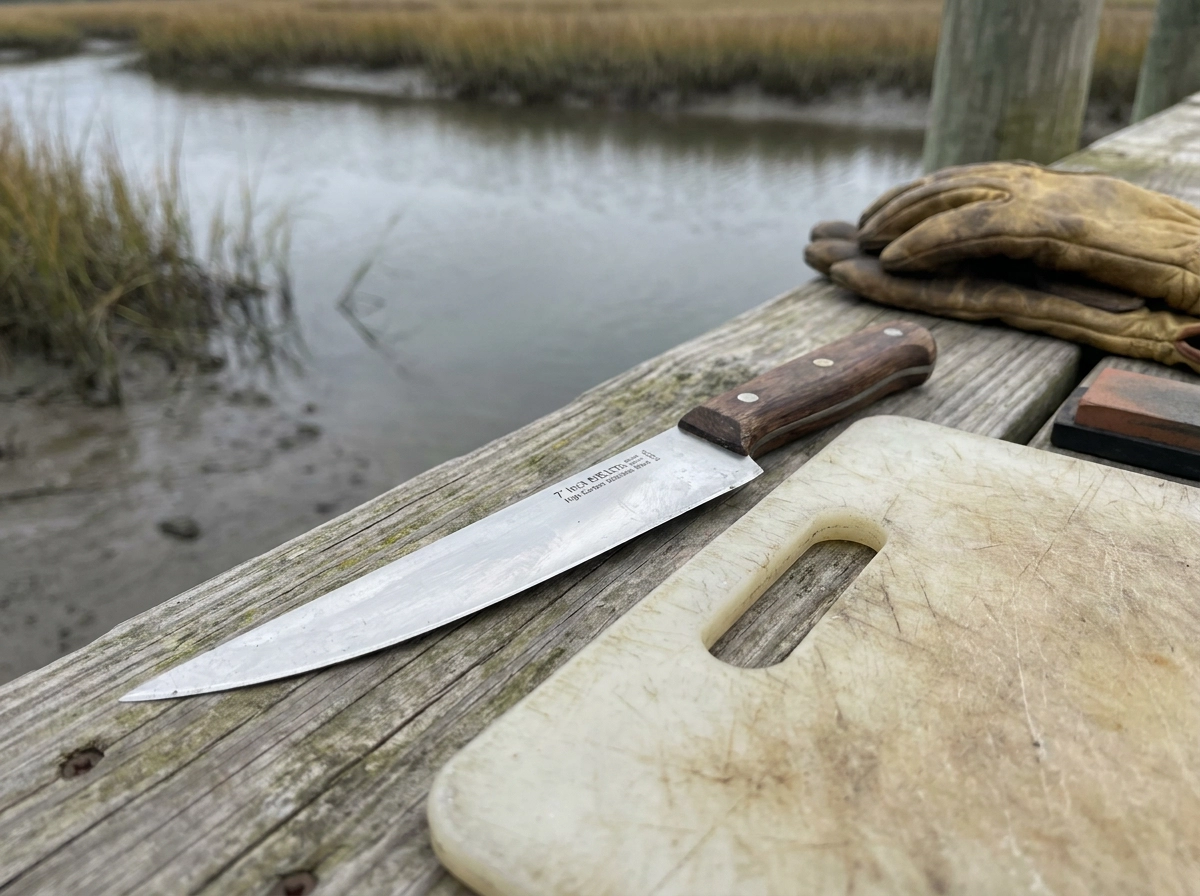
The two-knife case emerges when offshore species enter the rotation. Anglers running mixed trips targeting snapper, grouper, or king mackerel alongside inshore work benefit from pairing a 9-inch blade for the larger offshore fish with a 7-inch for inshore precision. The 9-inch eliminates mid-fillet repositioning on big-bodied fish where a 7-inch blade requires two passes.
A longer, narrow, highly flexible fillet knife in the 9–10 inch range is worth noting here: its length and flex profile translate directly to large redfish and stripers. If you already own one, it doubles as an effective bull red knife without buying a separate blade.
Kits that bundle a sheath, honing tool, and secondary utility knife are worth prioritizing over standalone purchases. The maintenance tools stay with the blade, which matters on a boat where loose gear disappears. A kit eliminates the gap between owning a quality knife and having what you need to keep it sharp.
For guide services and charter operations, two knives in the $40 to $60 tier generally make more sense than a single knife above $100, since redundancy outweighs marginal quality gains across a full day of multi-species processing.
The Specification Checklist: What to Buy and Why It Matters
Whether you're buying your first dedicated saltwater knife or replacing one that didn't survive the season, the decision reduces to five specifications. Match all five and the knife works. Miss one and you'll feel it on the cleaning table.
Steel: High-carbon stainless, often designated 420HC or similar, is the baseline that balances edge retention with corrosion resistance in a saltwater environment. Standard stainless and pure carbon steel each give up one of those qualities in ways that matter across a full season.
Blade length: A 7-inch blade handles snook, slot redfish, and average flounder with a single lateral stroke. Step up to 9 inches for bull reds and larger offshore-adjacent species where a shorter blade requires two passes and leaves a seam in the fillet.
Flex: Medium flex is the most useful single specification for multi-species saltwater use. It seats behind hard scales, tracks flat skeletal structures, and arcs around rib cages where either extreme fails. The full case for this spec is covered in the Blade Length and Flex section above.
Construction: Full-tang steel through the handle, a non-slip synthetic grip, and a ventilated polymer sheath complete the checklist. These three features address handle joint corrosion, wet-dock safety, and moisture management between trips.
Budget: The $40-60 range delivers every specification above. A quality knife in this tier, rinsed immediately after use, dried before storage, and kept in a ventilated sheath, will outlast several cheap replacements and produce cleaner fillets across every inshore species you target.
Conclusion
Saltwater filleting demands more than a sharp edge. It demands the right steel, the right flex, and the right length matched to the species on your cutting board. High-carbon stainless holds up where standard steel fails. Medium flex handles everything from flat-bodied flounder to armored redfish to the complex rib cage of a snook. Full-tang construction and a ventilated sheath protect your investment between trips.
You do not need an expensive kit to get started. One well-specified knife in the $40-60 range, maintained properly, outperforms a drawer full of cheap replacements.
Use the specification checklist in this post before your next purchase. Match blade length to your target species, confirm the steel designation, and verify the handle construction. Buy once, rinse every time, and your knife will be ready every time the cooler is full.
Keep reading