How to Throw a Cast Net: A Step-by-Step Guide

Throwing a cast net looks effortless when someone's been doing it for twenty years. Getting there takes practice — but the technique itself isn't complicated. This guide breaks it down step by step, covers the most common mistakes beginners make, and explains how to adapt for different fishing environments.
Before you throw: set up the net correctly
Most bad throws start before the net leaves your hand. Getting set up properly makes everything downstream easier.
- Untangle fully. Lay the net flat on a clean surface and work from the horn outward. Never throw a partially tangled net — it won't open.
- Coil the hand line. Gather the hand line from the horn into loose, even coils in your throwing hand. About 6–8 coils for a 10 ft net. Too tight and it won't pay out; too loose and it tangles.
- Wet the net. A dry net doesn't open as cleanly. Dip it in the water before your first throw of the day.
The five-step throw (right-handed)
Step 1 — Hold the horn and hand line
Hold the horn in your right hand with the hand line coiled loosely around the same hand. The excess line hangs below your fist — don't loop it around your wrist. You need it to pay out freely.
Step 2 — Gather a section of net in your teeth
Grab the net about 1/3 of the way from the top and bite down gently. Yes, your teeth. This is how it's done. Hold it in your left front teeth — not your molars. This holds the upper third of the net while you load the throw.
Step 3 — Load the lower lead line
Reach down and grab a section of the lead line with your left hand — roughly the point directly opposite where your teeth are holding. Pull it up and drape it over your left forearm and wrist. The lead line should hang in a roughly even loop.
Step 4 — Wind and release
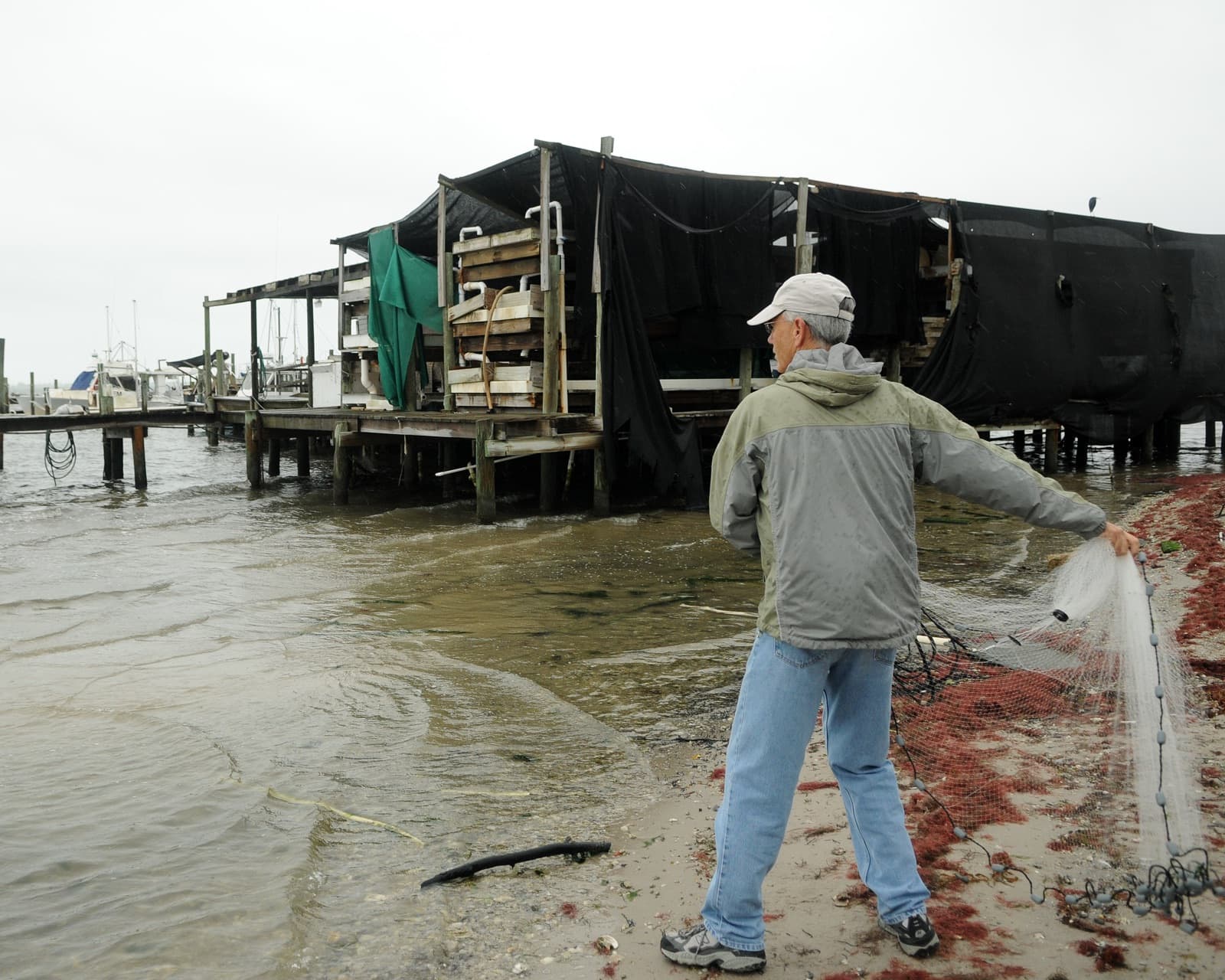
Rotate your body to the right (loading your core), then unwind and throw across your body in a sweeping arc. The key motion: open your left arm out to the right as you release, and let go of everything — the bite hold, the left-hand section, and the hand line — at the same moment. The net should unfurl in a wide, flat circle.
Step 5 — Let it sink, then retrieve
After the net lands, give it 2–4 seconds to sink. You'll feel a gentle weight on the hand line as the lead hits bottom. Pull hand line slowly and steadily — no jerking — to close the bottom of the net around the bait. Haul in hand over hand.
Left-handed throwing
The setup mirrors exactly. Horn in the left hand, bite hold on the right side of the net, lead line draped over the right forearm. The throw rotates left-to-right instead of right-to-left. Everything else is the same.
If you're ambidextrous, the right-handed throw tends to feel more natural to most people — but use whatever your dominant side is.
Common mistakes (and how to fix them)
- Net doesn't open fully:Usually a timing issue. You're releasing too early or too late. The left arm needs to pull outward as you throw — if it just drops, the net collapses. Practice the arm motion separately.
- Net lands in a clump: You let go of the bite hold too early. Wait until the throw is fully extended before releasing everything.
- Lead line tangles on retrieval:You're pulling too fast. Slow, steady hand-over-hand. Let the bottom close naturally.
- Hand line wraps around wrist: Never loop the line around your wrist. Keep it in loose coils in your palm. A wrap can pull you in or cause injury on a heavy throw.
- Can't hit the spot:You're aiming with your arm instead of your body. Your feet should be pointing at the target at the end of the throw. Rotate your whole body.
Tips by environment
Dock or pier
You have elevation, which helps. Stand at the edge, let the net hang freely before loading. Aim slightly downward — you want the net to land flat on the surface, not angled.
Wading in shallow water
The most common environment for cast nets. Keep your feet planted — don't try to throw while moving. Face your target at a slight angle so the body rotation sends the net in the right direction. Waist-deep water is ideal; anything shallower and the lead line catches bottom before closing.
Throwing from a boat
Space is tight. Use a shorter throw with more vertical launch. If you're in a fiberglass boat, consider the Sports Series— PVC-coated sinkers won't scratch your hull. Throw from the bow or stern — throwing mid-ship over a gunnel is asking for a tangled mess.
How often should I practice?
Twenty throws in a backyard or park will do more for your technique than reading any guide. Set up a tarp on the grass and throw for 20 minutes. You'll figure out your timing faster through repetition than instruction.
Most beginners nail a good open throw within their first 30 attempts. By throw 50, it starts to feel natural.
Not sure which net to practice with?
Beginners do best with a 6–8 ft radius net. Light enough to throw easily, large enough to actually catch bait. See our full sizing guide for more detail.
Browse more guides